Nusa Penida
Nusa Penida is the rugged island off Bali’s southeast coast, a forty five minute boat ride from Sanur that feels a world away. Above the water it is all sea cliffs, hidden beaches and a cave temple, below it, two of Indonesia’s most reliable big animal encounters such as manta rays year round and the strange mola mola in season. Most people come for a day. The ones who stay a few nights get the better island.
Penida is the largest of three islands sitting between Bali and Lombok, and the wildest. The roads are still rough, the cliffs are genuinely big, and the famous viewpoints have not lost their pull even as the crowds have grown. It rewards an early start and a bit of planning. Here is what the island is really about, above and below the surface.
The name itself gives a clue to how Bali sees the island. Nusa Penida translates roughly to “island of priests,” and for centuries it carried a heavier reputation than that, a place of exile for outcasts and criminals from the Balinese kingdoms, isolated and widely feared. Balinese belief holds that the island is home to Ratu Gede Mecaling, a demon king said to unleash disease and misfortune on the mainland, and the island’s most important temple, Pura Dalem Ped, is built around that legend, still one of the most revered and heavily visited temples in Bali despite sitting on Penida rather than the main island. That mix of sacred and feared is very Balinese, good and bad are meant to coexist rather than cancel out, and it is worth knowing before you write the island off as just a viewpoint circuit.
The Lay of the Island
Nusa Penida is shaped like a tilted plateau with high limestone cliffs on the south and west coasts, gentler bays and beaches in the east and north. Most visitors land at Toya Pakeh or Banjar Nyuh on the calm north coast, where the boats, dive shops and most of the accommodation cluster. The interior is dry, hilly farmland dotted with small villages, and the spectacular stuff sits around the edges.
It splits neatly into two halves for sightseeing. The west loop takes in Kelingking, Broken Beach and Angel’s Billabong, plus Crystal Bay for a swim. The east loop covers Atuh and Diamond Beach, the Thousand Islands viewpoint and the Goa Giri Putri cave temple. Doing both in a single day is a rush. Over two days it is relaxed, which is one good reason to stay over rather than day trip.
The Cliffs and Beaches
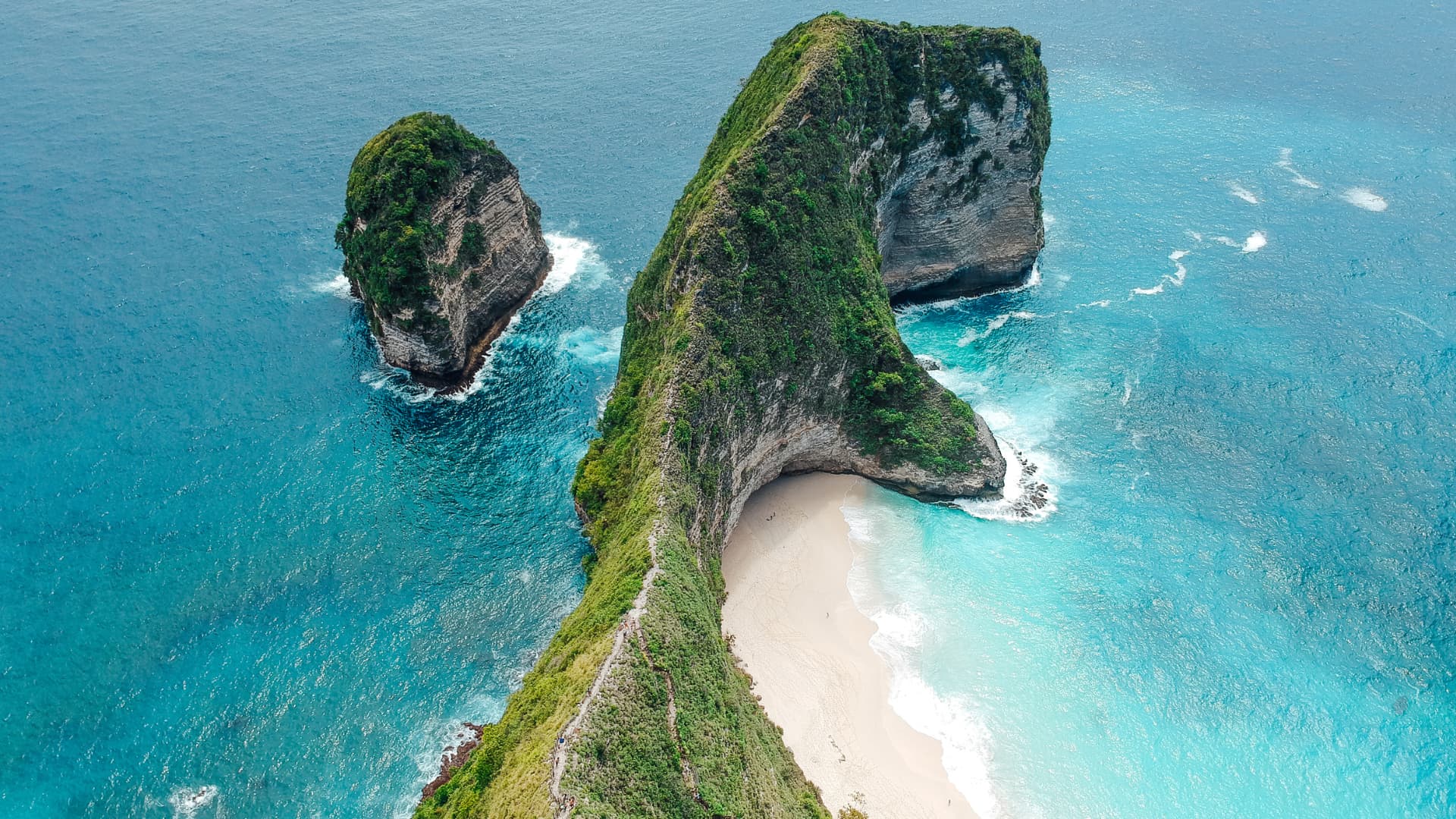
The west coast is where Penida earns its reputation. Kelingking Beach is the headland everyone has seen with a green spine of rock that looks like a sleeping T-Rex, with a sliver of white sand far below. The viewpoint is free and quick, the hike down to the sand is steep, hot and properly tiring, with a rope and timber path that is not for everyone. Go early, before the heat and the tour buses.


A short drive north, Broken Beach (Pasih Uug) is a near circular cove with a natural stone archway the sea runs through, and right next to it Angel’s Billabong is a natural rock pool that fills with clear water at low tide. Time your visit for low tide and calm seas, people have been swept off the rocks here when the swell is up, so it is a look don’t swim spot when the water is moving.
Over on the east coast, Atuh Beach and the neighbouring Diamond Beach sit beneath dramatic limestone stacks, reached by a steep carved stairway. Diamond is the postcard one, pale sand and turquoise water framed by rock pinnacles. The nearby Thousand Islands viewpoint (Raja Lima) looks out over a scatter of green islets in blue water. Crystal Bay on the west coast is the easiest swim and snorkel beach, a proper crescent of sand with shade and warungs, and the launch point for snorkelling and diving Penida’s most famous corner.
Our Nusa Penida land tour day trip covers the headline viewpoints with a local driver who knows the timing and the parking, and the snorkelling and land tour pairs a half day in the water with the cliffs in the afternoon. For full control over the route and pace, a private boat trip to Nusa Penida lets you reach quiet coves the day trip crowd never sees.
Goa Giri Putri and the Island’s Quieter Side
Penida is not only viewpoints. Pura Goa Giri Putri is a working Hindu temple inside a limestone cave, entered through a gap in the rock barely wide enough to squeeze through. It opens into a huge cavern lit by shafts of daylight, with shrines and active ceremonies. A sarong and sash are required, and a local priest blesses visitors at the entrance. It is one of the more memorable temple visits anywhere around Bali precisely because it asks a little effort.

Away from the famous stops, the island’s interior and east coast stay quiet with terraced farmland, seaweed farming villages on the shallow flats, and small warungs serving simple Indonesian food. If you want Penida without the queues, this is where to spend an afternoon. The island has a slower, rougher feel than mainland Bali, and that is most of its appeal.
The Sister Islands
Penida has two smaller neighbours, joined to each other and easy to fold into a trip. Nusa Lembongan is the developed one with mellow beaches like Mushroom Bay and Jungut Batu, surf breaks, beach bars and a relaxed backpacker meets honeymoon vibe. It is the soft landing of the three islands, with the most cafes and the calmest swimming.
Nusa Ceningan is the smallest and is linked to Lembongan by the famous Yellow Bridge, a narrow span you cross on foot or by scooter. It is home to the Blue Lagoon, a deep inlet ringed by cliffs where the brave go cliff jumping, plus mangrove channels and seaweed farms. Many travellers base on Lembongan for the comfort and hop across to Penida for the cliffs and the diving. A private boat charter makes island hopping the three Nusas straightforward.
Scuba Diving in Nusa Penida
Diving is half the reason to come, and it is a genuine step up from mainland Bali’s gentle sites. Penida’s water is cooler and the currents are stronger, driven by the channel between the islands, and that nutrient rich flow is exactly what pulls in the big animals. This is current diving for confident divers, not a beginner’s playground, though there is room for newer divers at the calmer sites with the right guide.


Top Dive Sites
Manta Point is a cleaning and feeding station on the exposed south coast where reef mantas show up year round, often several wheeling over the station at once. The surge can be punchy, but the payoff is the most reliable manta diving in Bali.
Crystal Bay is the mola mola hotspot in season, clear water over a rocky, dramatic seabed. The cold thermocline that brings the sunfish up can drop the temperature sharply, so this is where the extra neoprene earns its place.
Toyapakeh is a colourful, fishy wall and slope on the calmer north side, one of the prettiest reefs in the area and a good warm up dive.
SD Point and Mangrove Point are drift dives along healthy reef with turtles, reef sharks and schooling fish, riding the current past coral that is in good shape.
Northern Dive Sites like Malibu Point and Gamat Bay hold the calmer north face of the island, mild to moderate current over dramatic drop offs and coral gardens dense with macro life, nudibranchs, mantis shrimp, blue spotted stingrays working the sand and rock. Reef sharks, barracuda and the occasional passing tuna still cruise past, so this is where wide angle and macro rigs both earn their keep.
What you will see: reef mantas (year round), mola mola (seasonal), turtles, white tip and grey reef sharks, bumphead parrotfish, and big schools over healthy hard coral.
A safety note: these are current driven, advanced dives and conditions shift with the tide and season. Every dive gets briefed in real time with sites adjusted accordingly, safety comes first, always.
Best time to dive: diving runs all year. Mantas are reliable at Manta Point in every season. The mola mola window is roughly July to October, when cold upwellings bring the sunfish up to cleaning stations, with the peak around August and September. The dry season (April to October) gives the best surface conditions.
Conditions and level: currents at Manta Point and Crystal Bay can be strong and unpredictable, and the water is noticeably colder than the rest of Bali, so a 5mm wetsuit is sensible, more in mola season. Open Water divers can dive the calmer sites with a good guide; the exposed sites suit Advanced or genuinely confident divers. Sites get matched to your level, nobody gets pushed onto a current dive they are not ready for.
Most divers visit on a Nusa Penida scuba diving day trip from Bali, which is enough for Manta Point plus a second site. If you want to add the certification, we run Open Water and beyond courses here, and divers who want to string Penida into a longer route can join a Bali dive safari or the 13 day Bali and Nusa Penida safari.
The Easy Way to Meet the Mantas
You do not need to dive to swim with mantas. Penida’s snorkelling is some of the best around Bali, and the same sites that make divers happy work brilliantly from the surface. A typical snorkel trip hits a circuit of Manta Point (or Manta Bay, depending on conditions), Crystal Bay, Gamat Bay and Wall, where you drift over coral and reef fish with a guide watching the current.
Mantas at the surface are a thrill anyone can have, no certification needed, and the water is warm enough to enjoy for hours. We run a Nusa Penida snorkelling day trip from Bali and, for groups who want the boat to themselves, a private snorkelling trip with the manta rays. Sea conditions at Manta Point can be lumpy, so it suits confident swimmers more than total beginners on a rough day.
Getting There and Getting Around
Fast boats run from Sanur on Bali’s southeast coast to Nusa Penida in 45 minutes, with frequent departures through the morning. There are also crossings from Padang Bai in the east and direct boats from Nusa Lembongan. We arrange the boat, the transfers either side and the diving so you are not juggling tickets at a chaotic beach jetty.
On the island itself, distances are short but the roads are rough and steep in places, and traffic clogs the famous viewpoints by mid morning. The cleanest option is a car with a local driver, included in our land tours, which skips the parking scrum and keeps the timing handled. Scooter rental is popular and cheap, but the hilly, broken roads catch out inexperienced riders, and the run down to Kelingking and back is not the place to learn. If you are diving, the dive operation handles transport to the sites by boat anyway.
Best Time to Visit
Penida is a year round destination with warm tropical weather throughout. The dry season, April to October, brings the clearest skies and the calmest seas, ideal for the boat crossing, snorkelling, diving and the cliff top hikes. May to September is the sweet spot above water.
The wet season, November to April, sees brief afternoon showers rather than all day rain, with fewer crowds at the viewpoints and lower prices. For divers, the headline is the mola mola window of July to October, which overlaps neatly with the best surface conditions. Mantas, the island’s signature draw, are there in every month.
Penida in a Bali Trip
Nusa Penida is the easiest big animal add to a Bali itinerary, near enough for a day but worth more. A good rule of thumb, one day gets you either the cliffs or the diving, two days gets you both at a civilised pace, and three lets you bring in Lembongan and Ceningan. It slots naturally after a few days around Ubud or the east coast, and pairs well with the diving at Amed and Tulamben on the mainland if you are building a wider underwater trip.
Frequently Asked Questions
A day trip works if you only want the headline viewpoints or a single round of diving. To do the island justice, stay two nights where one day for the west coast cliffs (Kelingking, Broken Beach, Angel’s Billabong), one for the east coast and the diving or snorkelling, with time left for Lembongan and Ceningan on a third.
Above the water, dramatic sea cliffs and beaches, especially Kelingking, Broken Beach, Angel’s Billabong and Diamond Beach, plus the Goa Giri Putri cave temple and the island’s deep place in Balinese Hindu legend around Ratu Gede Mecaling. Below it, year round manta rays at Manta Point and the seasonal mola mola at Crystal Bay. It is one island that delivers both a landscape trip and a serious dive trip.
The dry season, April to October, has the calmest seas and clearest skies, best for the boat crossing, hikes and water activities. May to September is the sweet spot. Divers chasing mola mola should target July to October. Mantas are reliable all year.
Fast boats leave Sanur in Bali and reach Penida in 45 minutes, with crossings also from Padang Bai and Lembongan. We handle the boat, transfers and any diving or tours so the logistics are sorted before you arrive.
Roads are rough and steep, and the viewpoints jam with traffic by mid morning. A car with a local driver is the easiest way to see the sights and is included in our land tours. Scooters are cheap but the hilly, broken roads are unforgiving for inexperienced riders.
Yes. Snorkelling at Manta Point and Manta Bay puts you in the water with mantas, no certification needed, and Penida’s snorkelling is excellent. Surface conditions can be choppy, so it suits confident swimmers on a rough day.
Some sites are, with a good guide, but Penida is a current driven, cooler destination. Manta Point and Crystal Bay suit Advanced or confident divers, calmer sites like Toyapakeh work for newer divers. Open Water courses can run right here on the island.
If you have the time, yes. Lembongan is more developed and relaxed with the best swimming beaches, Ceningan, linked by the Yellow Bridge, has the Blue Lagoon and cliff jumping. Penida has the big cliffs and the diving. A private boat charter makes hopping all three straightforward.
Your adventure starts here
Plan your trip to Nusa Penida
Tell us what you want to see and we'll craft the perfect itinerary, usually within 24 hours.
Plan My Trip →Enquire About This Destination
Any question, special request or custom itinerary, we reply within 24hrs.