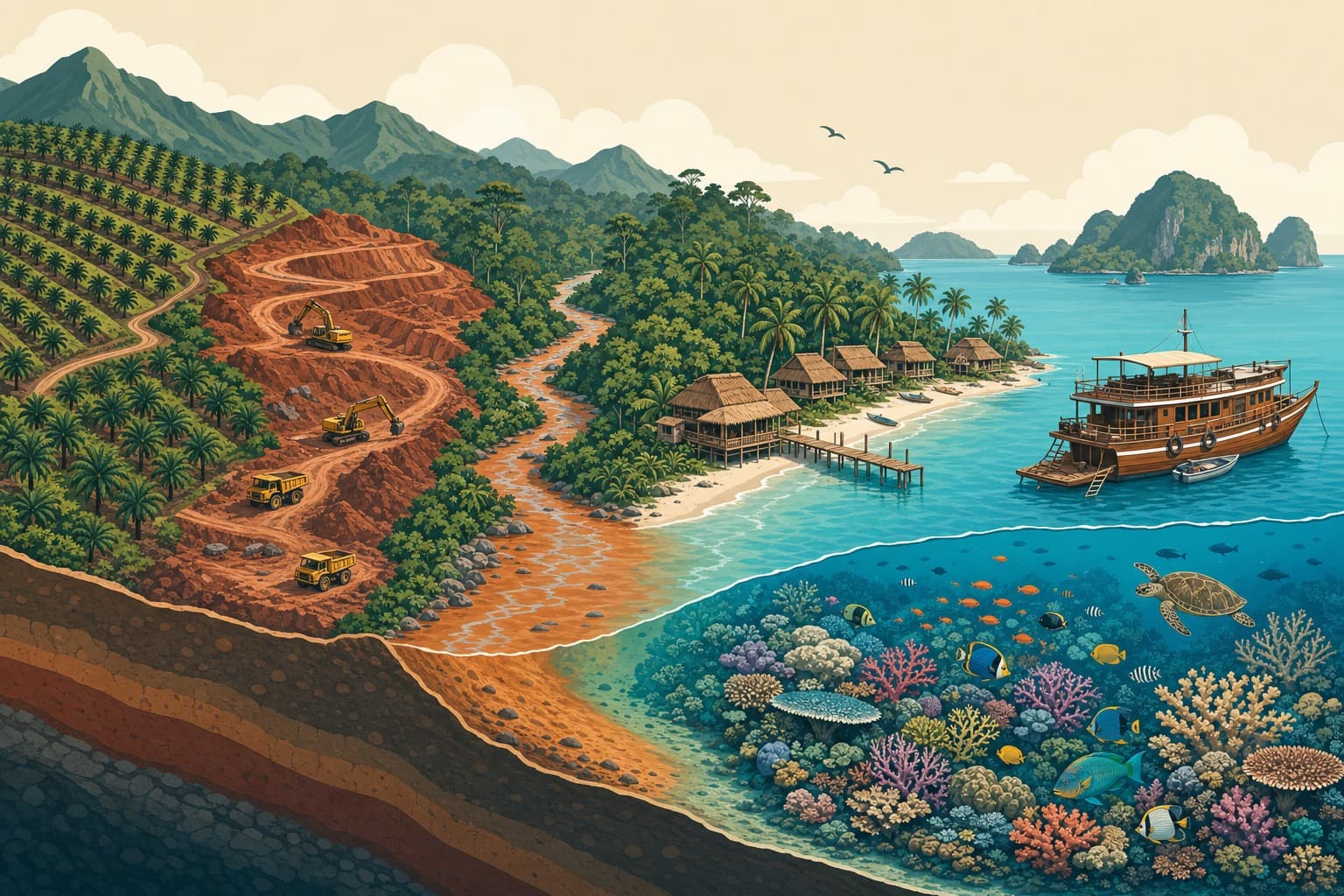
Every reef in Indonesia has a forest behind it. The two are, in fact, the same system. When you understand that, you understand why the best diving on the planet is also some of the most fragile.
Drop onto a wall in Raja Ampat and the water feels endless, blue and full of life. It is easy to think of a reef like this as its own world, sealed off, protected by sheer distance from anything people do on land. It is not. What falls on the mountains behind the coast, what grows there, and what gets cleared there all end up in the water sooner or later. Divers are often the first to notice when something upstream has changed.
The water carries everything downhill
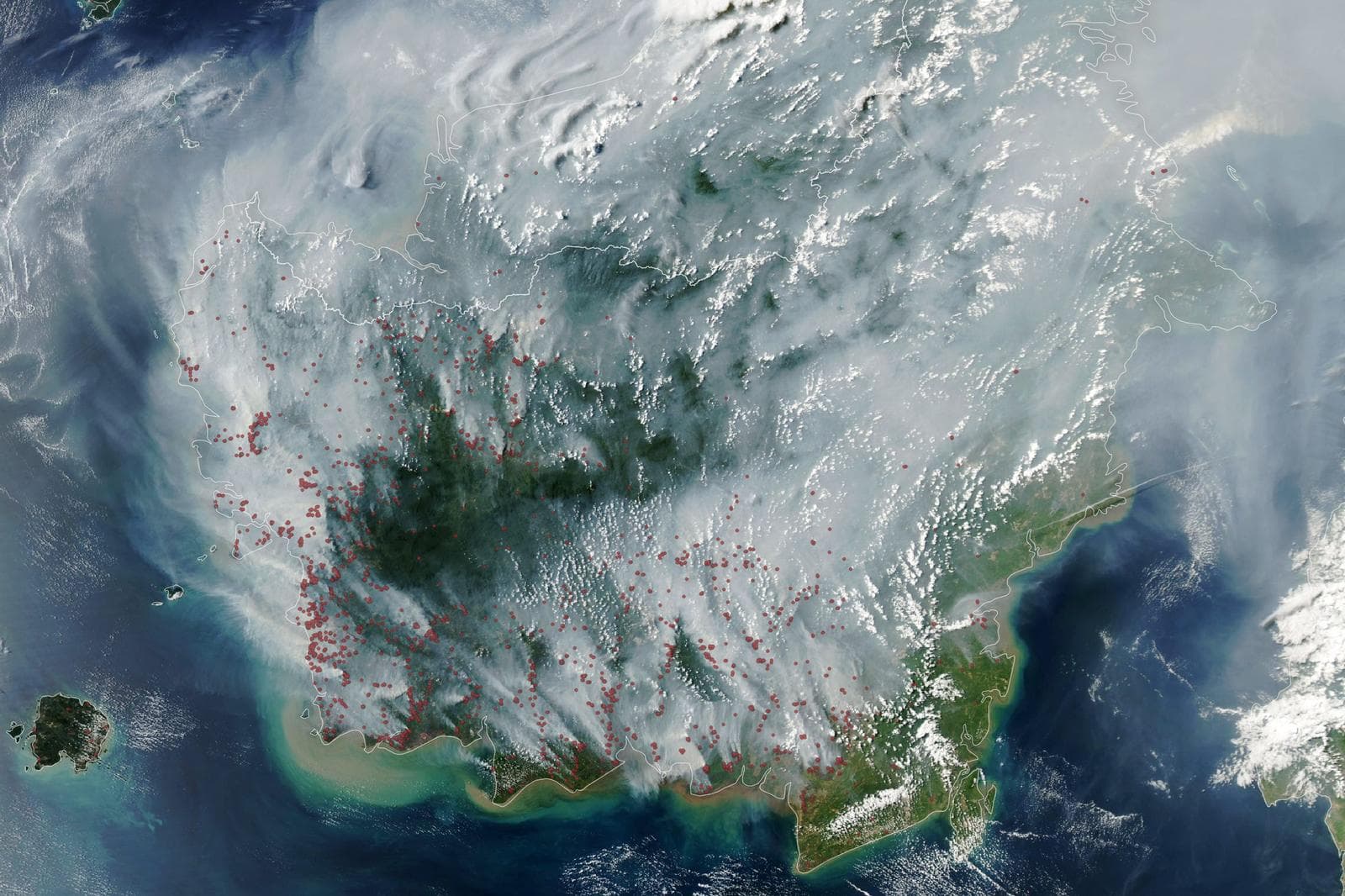
The link is simple physics. Rain hits high ground and runs to the sea, and it takes whatever is loose with it. When a forest covers the slope, its roots hold the soil in place and the water that reaches the coast runs relatively clear. Strip that forest for a plantation, a road or a mine, and the same rain now carries loose earth straight onto the reef.
Coral does not cope well with that. Sediment clouds the water and blocks the light that coral needs to feed through the algae living in its tissue. Fine silt settles on the coral itself and smothers it. Add the fertiliser and nutrients that wash off farmland and you feed the fast-growing algae that then crowd the coral out. None of this is dramatic from the surface. It shows up slowly, as murkier water, greyer reefs and thinner fish life, over years rather than weeks.
Between the land and the reef sit two quiet defences: mangroves and seagrass. Mangrove roots trap sediment before it reaches open water and act as a nursery for reef fish. Seagrass meadows filter the water and store carbon. Clear the mangroves for a shrimp farm or a coastal resort and you remove the reef’s filter at the exact moment it needs it most. This is why the health of a dive site can hinge on a stretch of muddy coast that no diver ever visits.

Mining tells the same story, sometimes right on a dive site
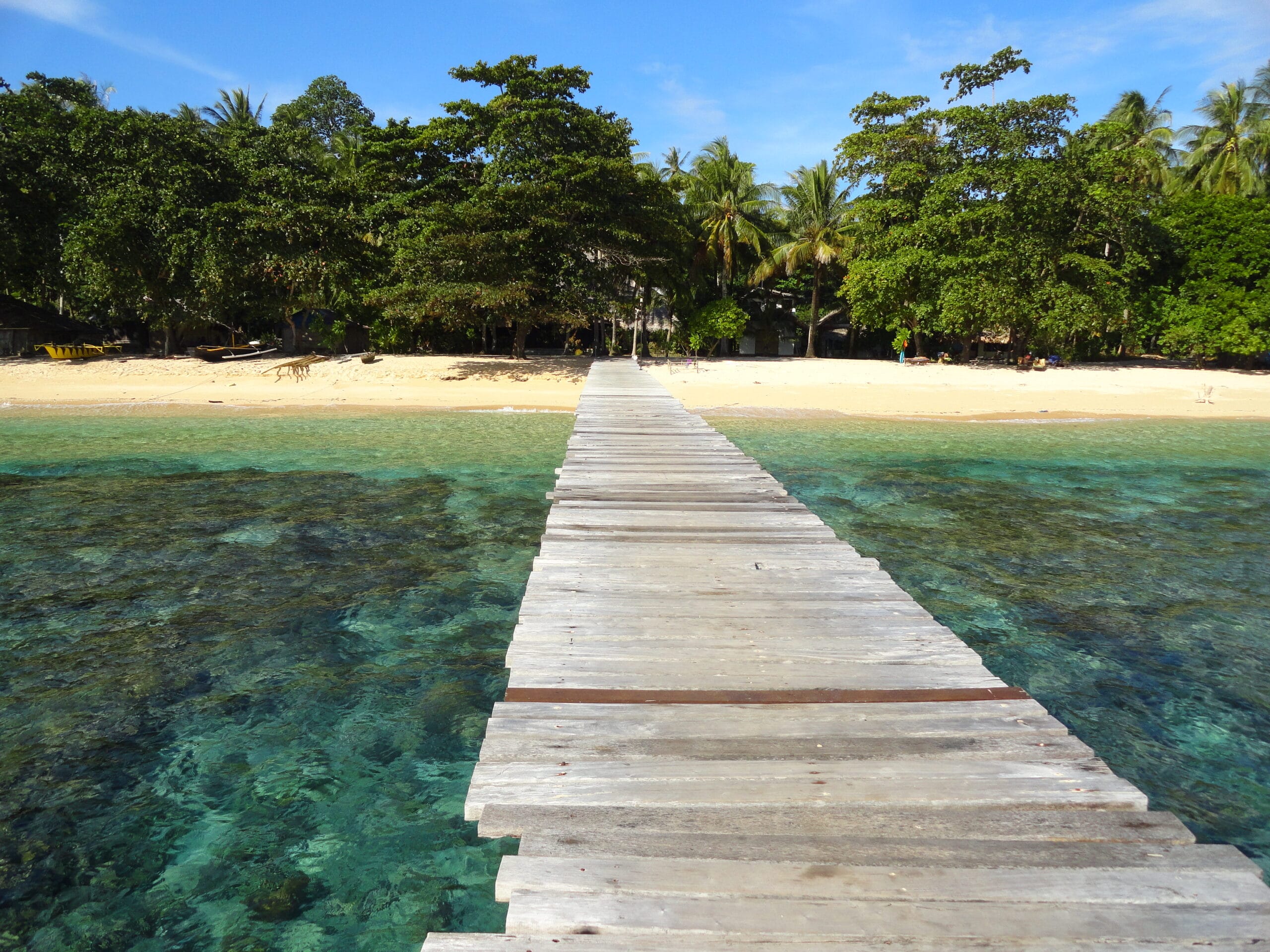
If deforestation is the slow version, mining is the sharp one, and one case sits directly on a reef divers know. Bangka is a small island of about 48 square kilometres off the northern tip of Sulawesi, at the centre of the Coral Triangle, a well-known spot for macro diving with pygmy seahorses, turtles and even the occasional dugong. For years it was also the target of an iron ore project, and residents and dive operators said the coastal excavation and land reclamation were damaging the very reefs the island lives on. So they fought it, through the courts, and they won: Indonesia’s Supreme Court ultimately sided with the islanders against the permit. It is one of the clearest examples anywhere of a diving community defending its own reef and winning.
Further south and east, the pressure is heavier and newer. Sulawesi has become a centre of Indonesia’s nickel boom, the metal that goes into electric-vehicle batteries. Around industrial areas like Morowali, the clearing of land for mines and smelters has been linked in peer-reviewed work to a measurable drop in coastal water clarity, and studies have found that nickel ore washing into the sea can harm coral within days. In 2021 a single barge ran aground near Morowali and spilled roughly 7,000 tonnes of nickel ore, damaging more than 2,000 square metres of reef. Fishing and seaweed-farming communities along these coasts have reported murkier water and smaller catches. Whatever you think of the economics, the reef ends up downstream of the decision.
And then it reached Raja Ampat
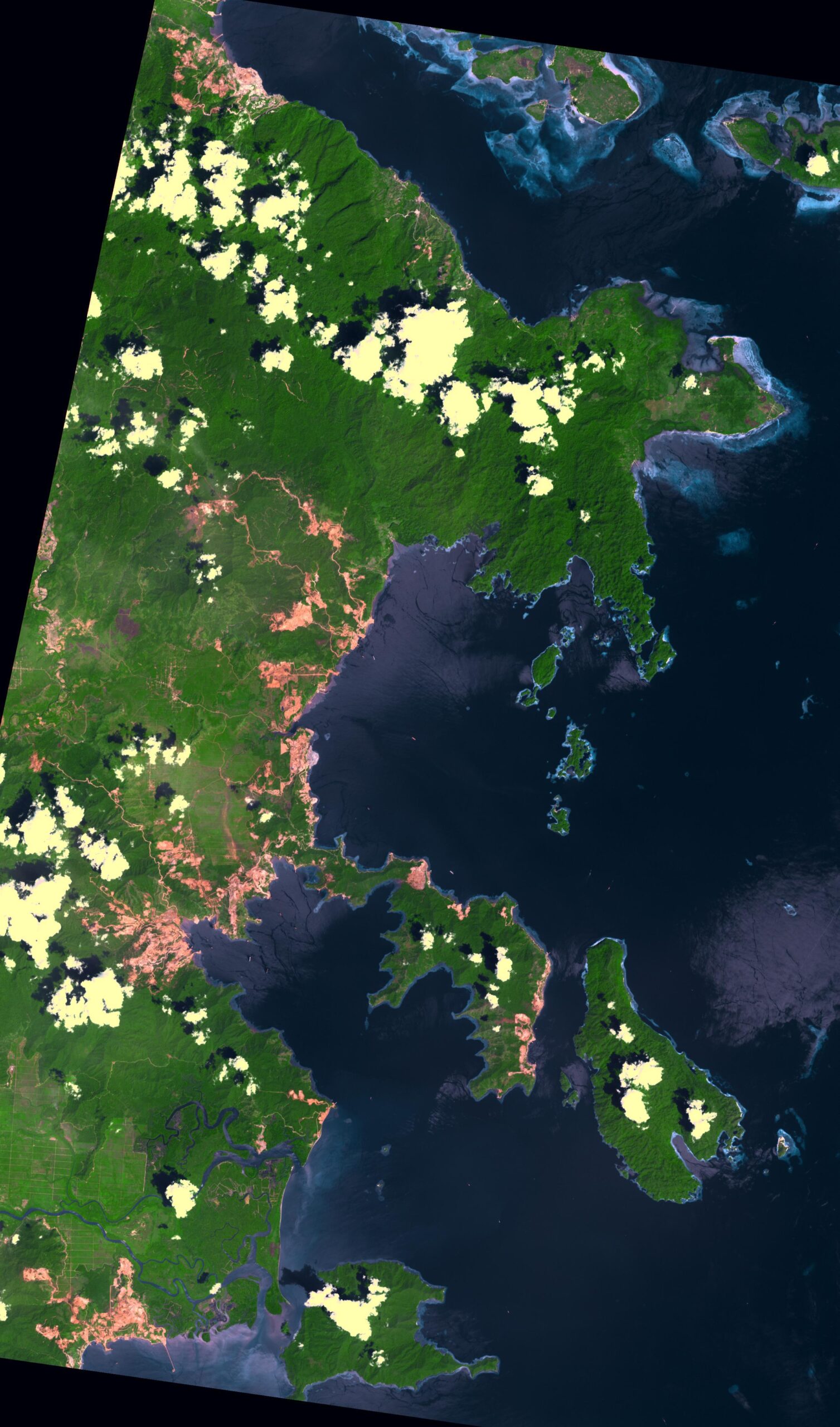
In mid-2025 this stopped being someone else’s problem for divers. Footage of cleared hillsides and red runoff bleeding into the sea around the islands of Gag, Kawe and Manuran spread online, the hashtag #SaveRajaAmpat went viral, and for once it moved the needle. In June the government revoked four of the five nickel mining permits in the archipelago. Greenpeace had documented more than 500 hectares of forest and vegetation already cleared on those islands. For a place that holds roughly three quarters of the world’s known coral species and more than 1,700 kinds of reef fish, and that UNESCO named a Global Geopark in 2023, it was a real reprieve. We wrote about that decision at the time.
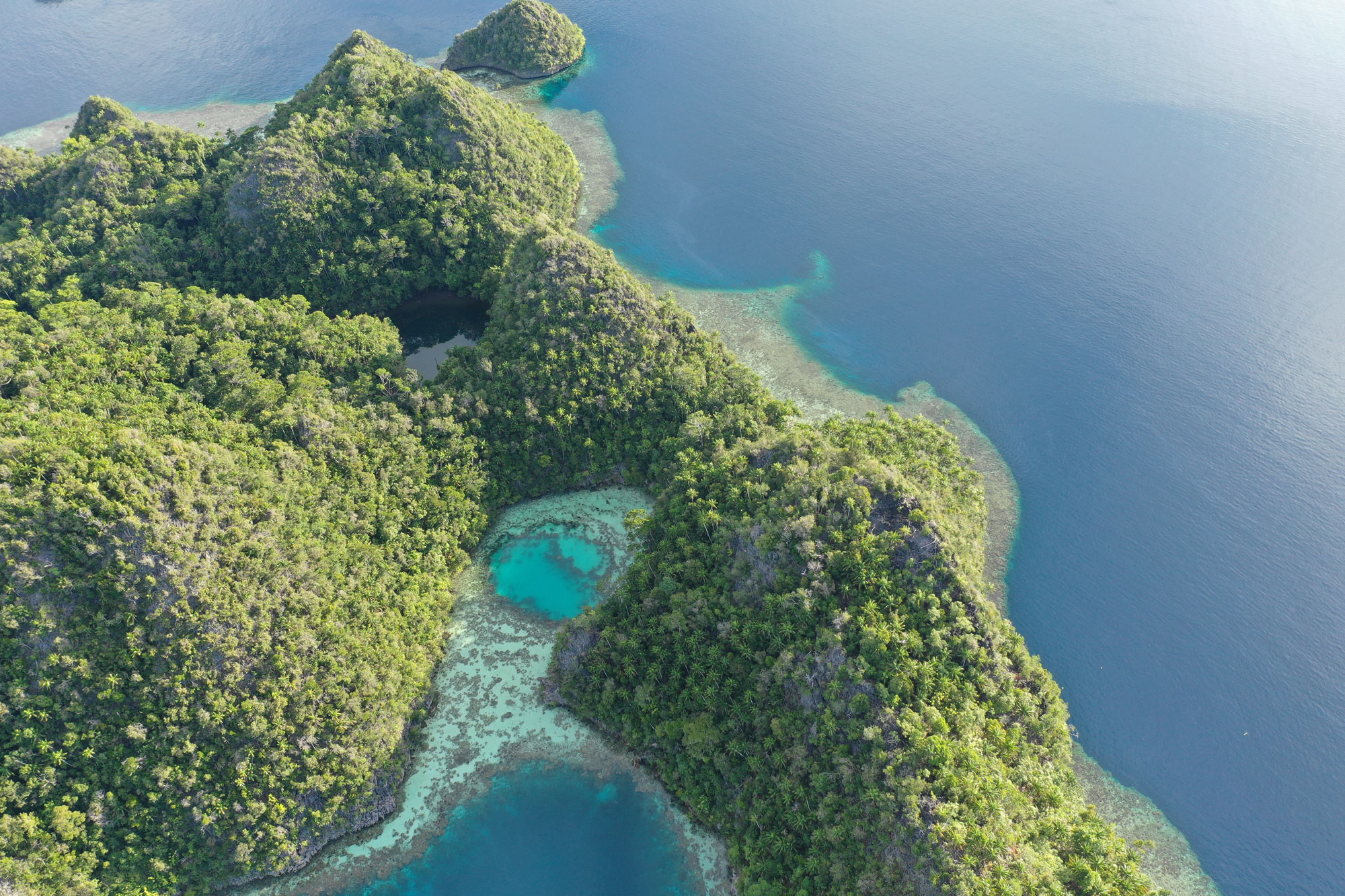
It was not the end of the story. The fifth permit, held by state-owned PT Gag Nikel, was never cancelled, and in September 2025 the company resumed mining on Gag Island after the moratorium was lifted. A new concession of around 3,000 hectares later surfaced on the government’s own mining-data portal for Waigeo, the largest island in Raja Ampat. And the pressure has reached the north, near Wayag, the maze of jungle-topped karst islands that is the single most photographed view in all of Raja Ampat. For a stretch, access to Wayag and nearby sites was closed while local communities protested. The place on the postcard became part of the argument.
We do not pretend to be neutral about this, even as we stay out of party politics. Raja Ampat is not an abstraction to us. It is where we take people to dive, and its reefs are the reason many of them fall in love with the ocean in the first place.
Tourism is part of the pressure too, and we are part of tourism
Mining and plantations are not the only thing bearing down on Raja Ampat. Diving itself is. It would be dishonest to write an article about pressure on these reefs and leave that part out, because we are not outside observers here. We send people to dive Raja Ampat every season.

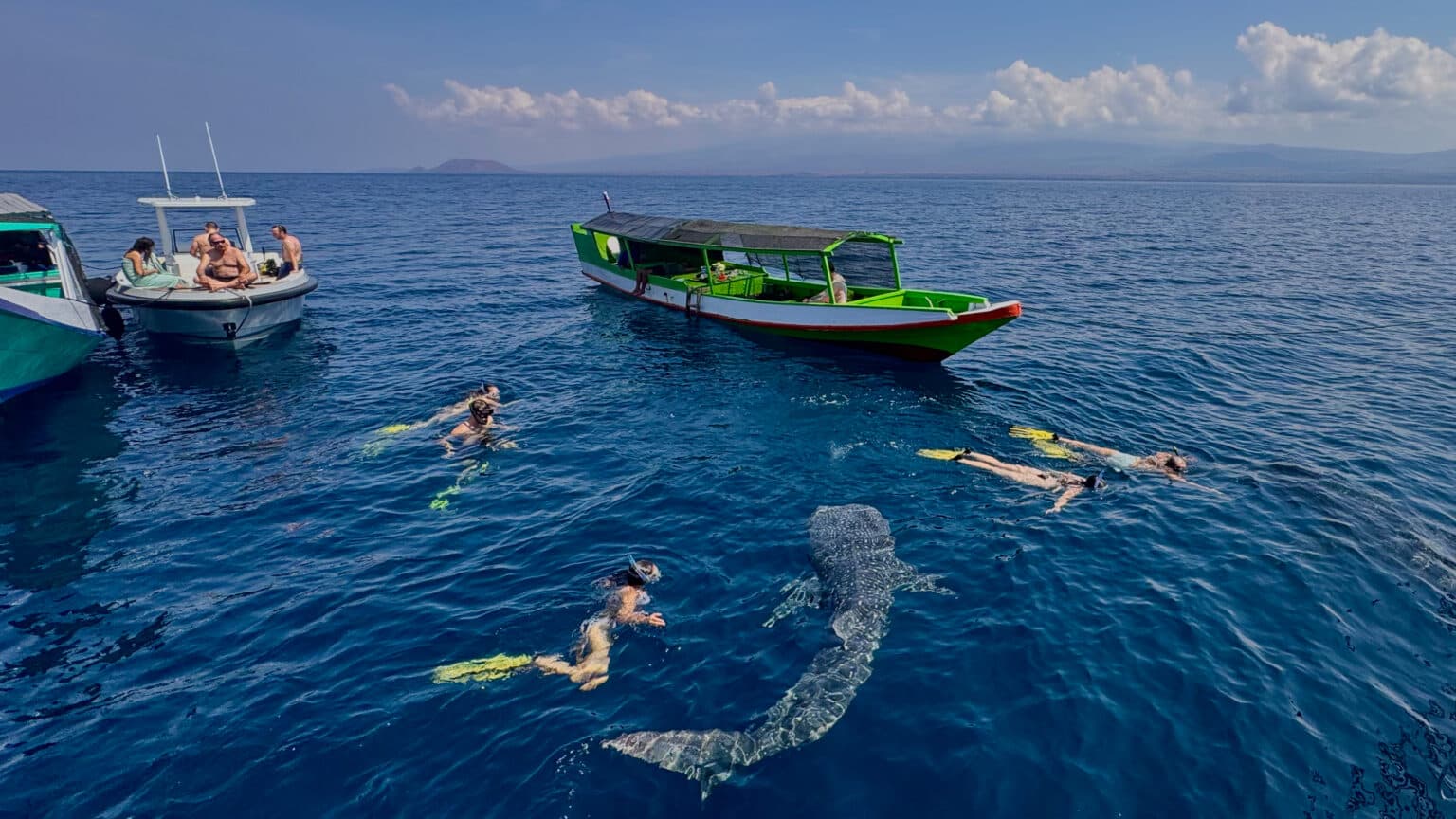
The research is not subtle. A carrying-capacity study of the Dampier Strait, the stretch of water that includes Kri and Sardine Reef, set safe per-site limits as low as a few dozen divers a day at some individual spots. The archipelago’s busiest manta cleaning stations already run past that. At Manta Sandy, as many as 50 divers have been dropped from nine boats at once, which is why rangers now cap it at 20 permitted divers a day. Manta Ridge nearby has no ranger post close enough to enforce the same limit, and operators routinely crowd it too, enough to visibly stress the animals and stir up the sediment they feed in. None of that requires a mine or a plantation. It is simply too many boats and too many fins over too small a patch of reef.
The other side of it is what tourism leaves behind. A 2025 waste-management study of the Raja Ampat Geopark put the islands’ annual tourism-linked waste at more than 15,000 tonnes, and rising, in a place with no real disposal infrastructure to deal with it. Homestays, resorts and liveaboards all generate sewage and grey water, and where there is no treatment, it goes straight into the same water the reef breathes. Plastic drifts in on ocean currents too, but a meaningful share of it starts at the docks, not out at sea.
We do not think the answer is fewer people caring about Raja Ampat. We think it is being honest that OET is part of this picture, not separate from it, and being deliberate about it: working only with liveaboards and homestays that manage their waste properly, spreading dives across sites instead of stacking everyone on the same reef at the same hour, and steering guests toward the archipelago’s quieter corners in peak months rather than only the postcard spots. Raja Ampat’s own Homestay Association, run by local communities, already grades stays on exactly this kind of environmental practice, and it is worth booking through operators who take that seriously.
The forests are the other half of the story
Mining hits the coast and the islands. Inland, the pressure is palm oil, pulp and large-scale agriculture, and here too the frontier has moved to Papua, the last great stretch of intact forest in Indonesia. The same province that holds Raja Ampat also holds some of the largest forest-clearing projects in the country. Whatever comes off those hills, sediment, nutrients, whatever the rain can carry, eventually reaches the same sea the reefs sit in. The diving and the forest are one catchment, not two separate stories.
A documentary worth watching: Pesta Babi
If you want to understand what is happening on land in Papua right now, one recent film has put it in front of a wide audience. Pesta Babi: Kolonialisme di Zaman Kita is a 2026 documentary by Indonesian journalist Dandhy Dwi Laksono and Papua researcher Cypri Dale, made with environmental and legal groups. It follows Indigenous communities in South Papua as they respond to the expansion of palm oil and sugarcane plantations onto their ancestral land, and it lays out the scale of the forest conversion involved.
The film has been widely discussed in Indonesia since its release, screened community by community rather than in cinemas, and it has drawn strong reactions on all sides. We are not here to tell you what to conclude from it. We are recommending it as a piece of context. For divers and travellers who care about where they go, it is a clear, well-made look at the land-use decisions that sit upstream of some of Indonesia’s most spectacular coastlines.
What this means for how you travel
None of this is a reason to stay home. Tourism, done well, is one of the strongest arguments a coastline has for staying intact. A reef that brings divers and income is a reef a community has a reason to protect. Raja Ampat itself is proof: local marine tenure and community-run no-take zones are a big part of why the diving there is world class. Visitors are part of that equation, not separate from it.
What you can do is travel in a way that keeps the pressure on the right side of the ledger:
- Choose operators who put money back into the coast they use. Reef fees, ranger patrols and local hiring are not marketing lines, they are what keeps a site healthy.
- Favour local. Local guides, local crews, local stays. It keeps the value of the reef in the hands of the people who decide its future.
- Mind your own footprint underwater. Good buoyancy, reef-safe sunscreen, nothing touched, nothing taken. Basic, and it adds up across thousands of divers.
- Stay curious about the land, not just the water. The forest, the rivers and the mangroves are part of the same trip, even when you never leave the boat.
For more on travelling this way, see our guide to responsible, sustainable travel in Indonesia.
The reefs that make Indonesia the best diving on earth were not protected by distance. They were protected by the people who live alongside them and, increasingly, by the travellers who value them enough to tread lightly. What happens in the forest reaches the water. Worth remembering, next time you roll backwards off the tender into that impossible blue.