Published April 1st, 2026 – read the April 2nd update here
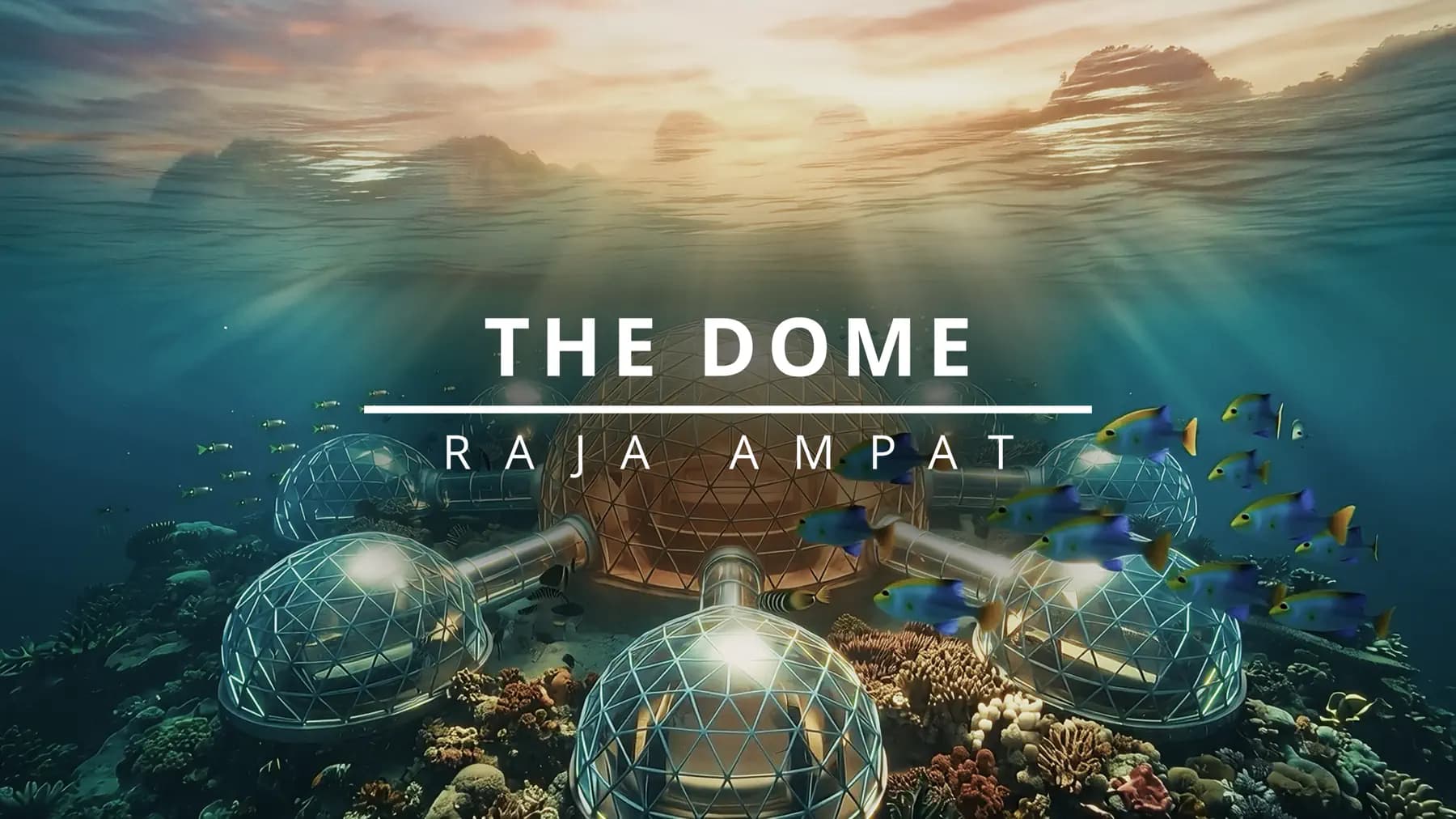
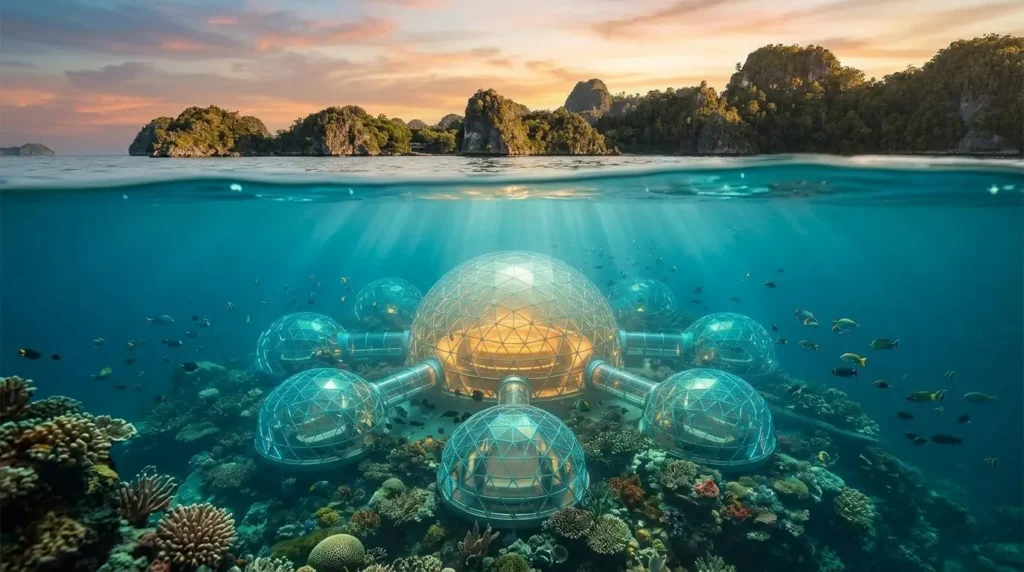
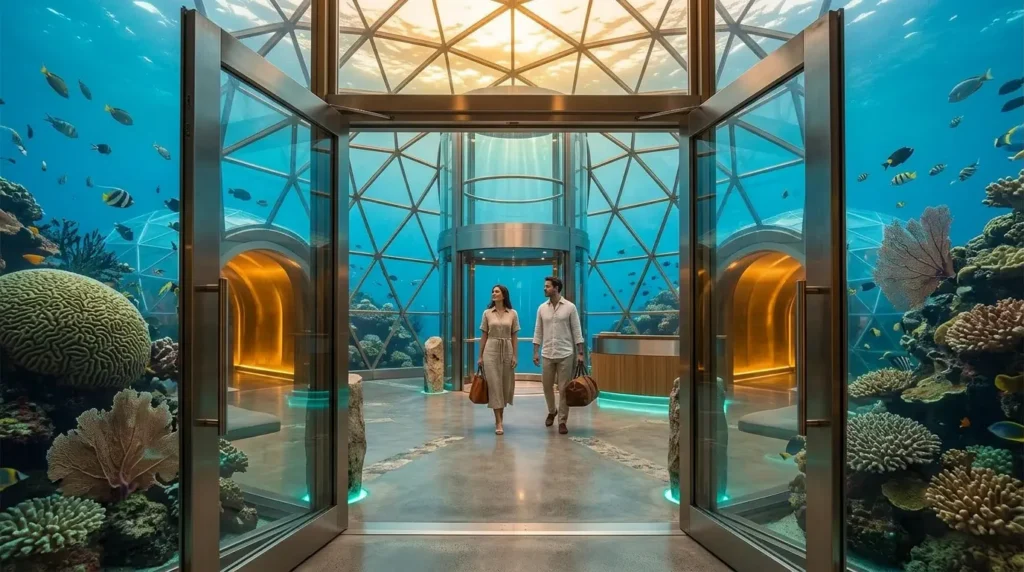
A few weeks ago, we got some news yesterday that didn’t feel real. A 40-meter transparent geodesic dome. Twenty meters below the surface. Golden light inside. Five smaller suite domes arranged in a circle. Transparent tubes connecting them like arteries in a living system. An above-water entry dome carved into the cliff face, descending into something that shouldn’t exist but does: The Dome Raja Ampat.
Our team spent six weeks verifying it. In the dive and luxury travel world, renderings are easy. Real projects are rare. And projects that combine genuine hospitality with measurable reef restoration? Nearly nonexistent. We had exclusive access to the renders, the architecture, and the mission behind the most ambitious conservation-hospitality project ever built. Here’s what we found.
THE ARCHITECTURE
What You See When You Arrive
A speedboat cuts through the water. The entry dome comes into view, built into the cliff face above the reef. Golden light spills from inside. You step into a transitional space: one side opens to air and sky and cliff, the other faces the open water below.
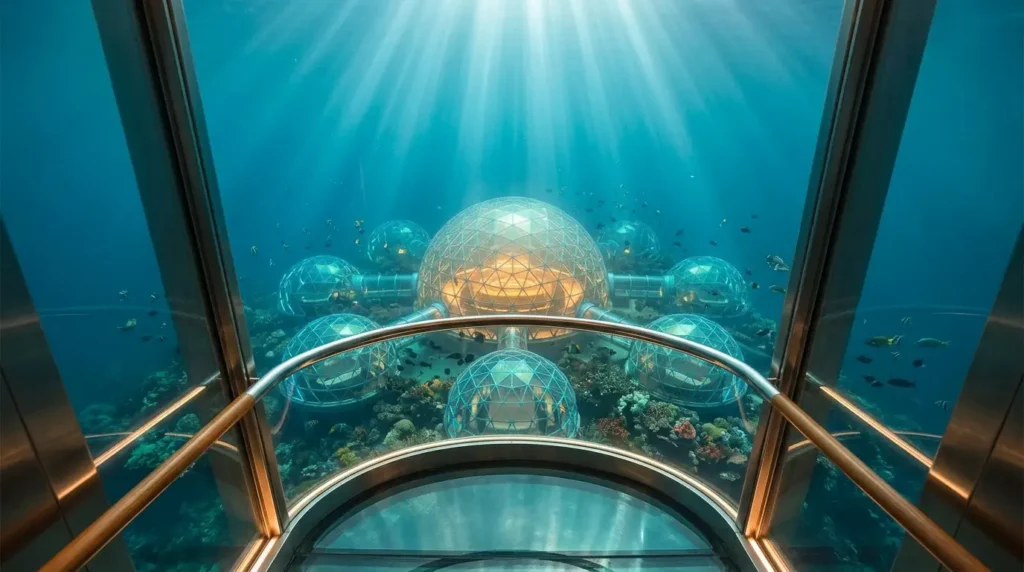
From here, a transparent descent pod lowers you down. Twenty meters. Slow enough to watch the shift happen. Turquoise becomes blue-green. Fish materialize. The seafloor appears. And then, through the water, glowing: The Dome.
The Sanctuary Interior
The central dome is 40 meters across. A cathedral space, enclosed in glass. The reef isn’t a view, it’s the room. Five smaller domes encircle it (12-15 meters each). Suite domes. Transparent tubes run between them.
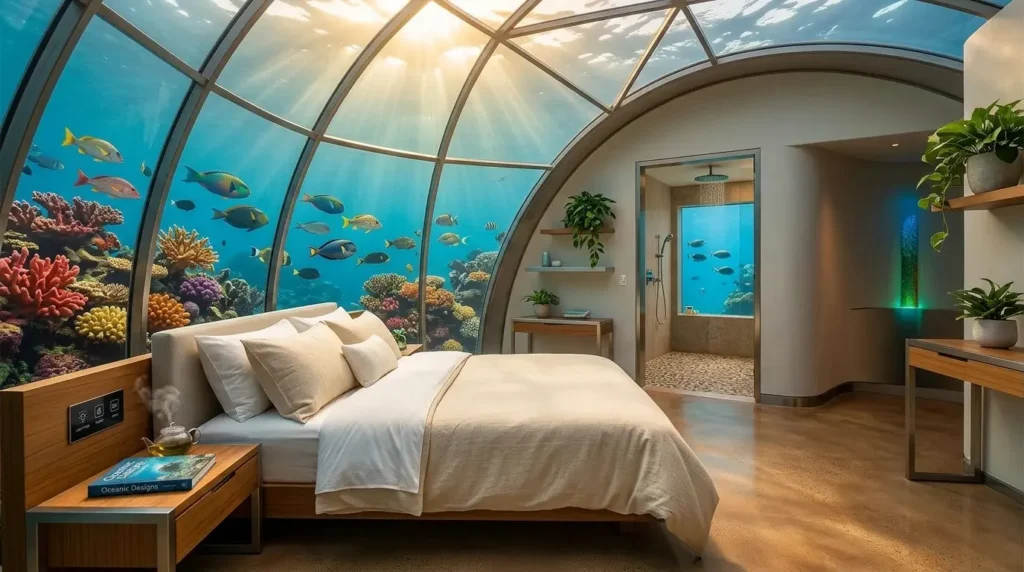
The Suite: A king bed against the curved wall. Your pillow faces the reef. Parrotfish graze at eye level. Surgeonfish. Emperors. You wake to the reef’s rhythm.
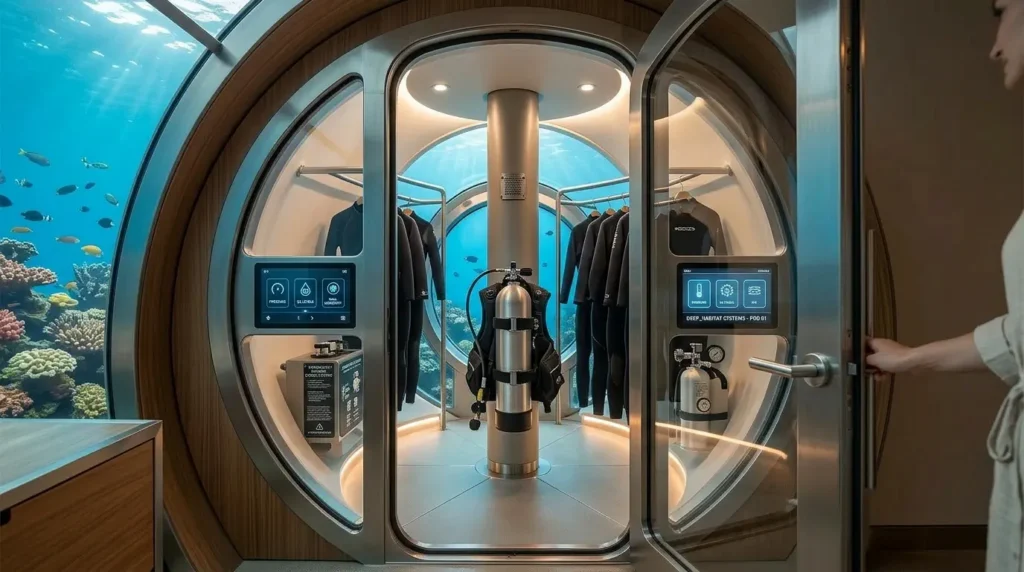
The Diving Pod: An acrylic lock built into your suite. Opens directly into water at 20 meters. Step out, enter, dive. Five seconds.
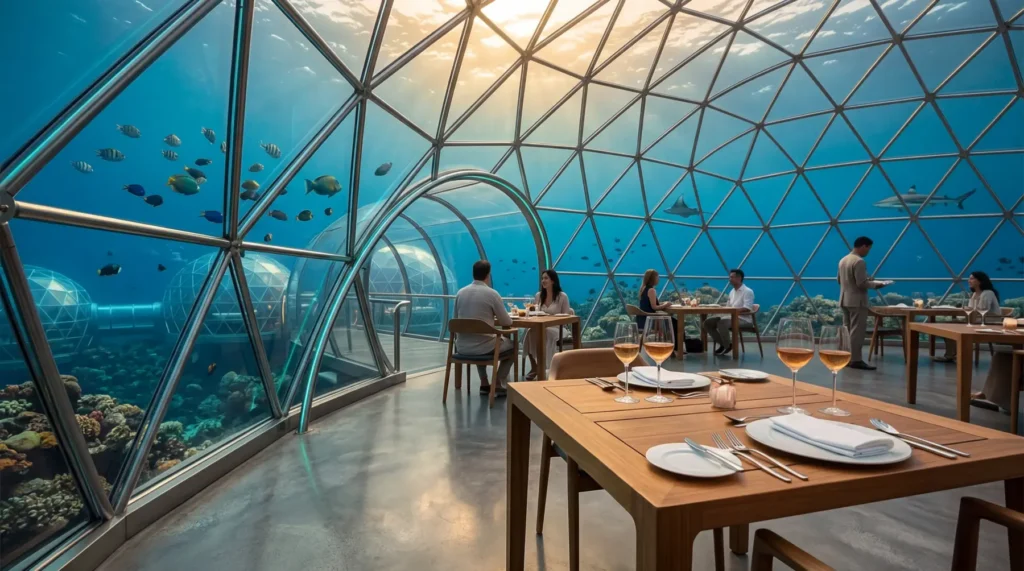
The Restaurant: The main 40-meter dome. Teak tables. Place settings. The coral garden surrounds you on all sides. Manta rays pass overhead. Reef sharks glide by. You dine inside the ecosystem.
Why This Matters
Most underwater resorts treat the reef as scenery. Pretty backdrop. Separate from you. The Dome is different. It doesn’t separate.
Transparent domes exist because you need to see what you’re supporting. You’re not looking at the reef. You’re inside it. The boundary is glass; visible, acknowledged, real.
THE SUSTAINABILITY
Zero-Impact Luxury
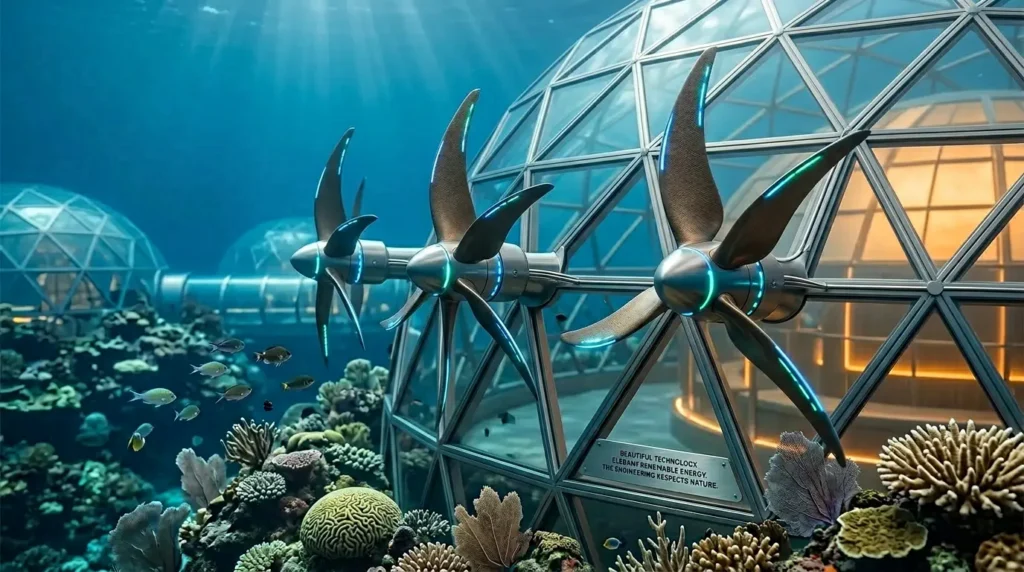
Energy: Tidal turbines shaped like manta rays, mounted on the exterior. They capture Raja Ampat’s tidal flows and convert them to power. No fossil fuels. No emissions.
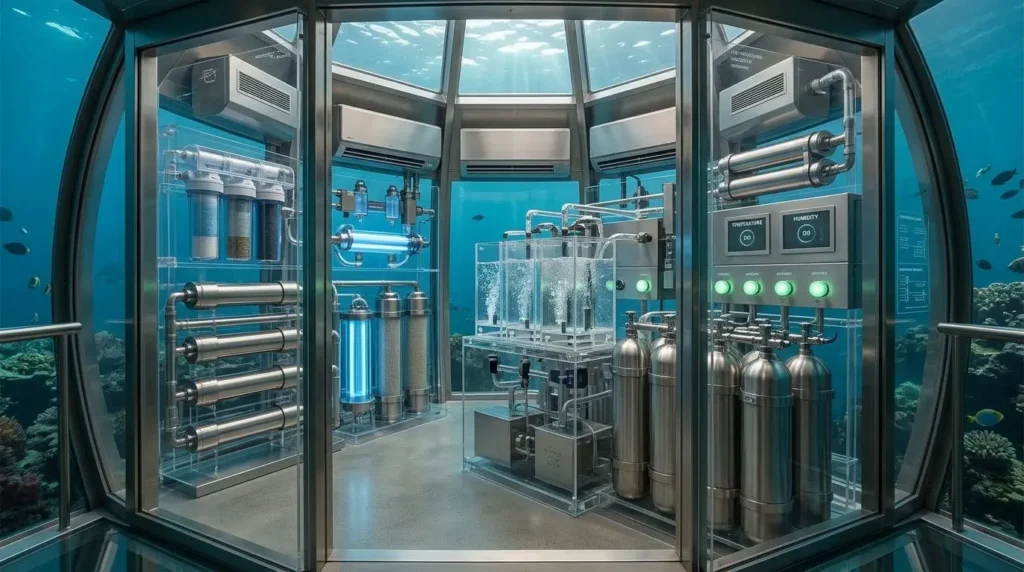
Water & Air: Fresh water is generated on-site: multi-stage desalination, reverse osmosis, UV sterilization, recycling. Two independent oxygen systems (one mechanical, one biological) run in parallel. You can see them operating through acrylic panels. It’s not hidden infrastructure, it’s visible, working proof.
The biosphere component is the innovation: algae gardens and air-purifying plants integrated into the interior design. They don’t just exist in a back room. They’re part of the living space. Guests watch how nature works alongside technology to keep the system running.
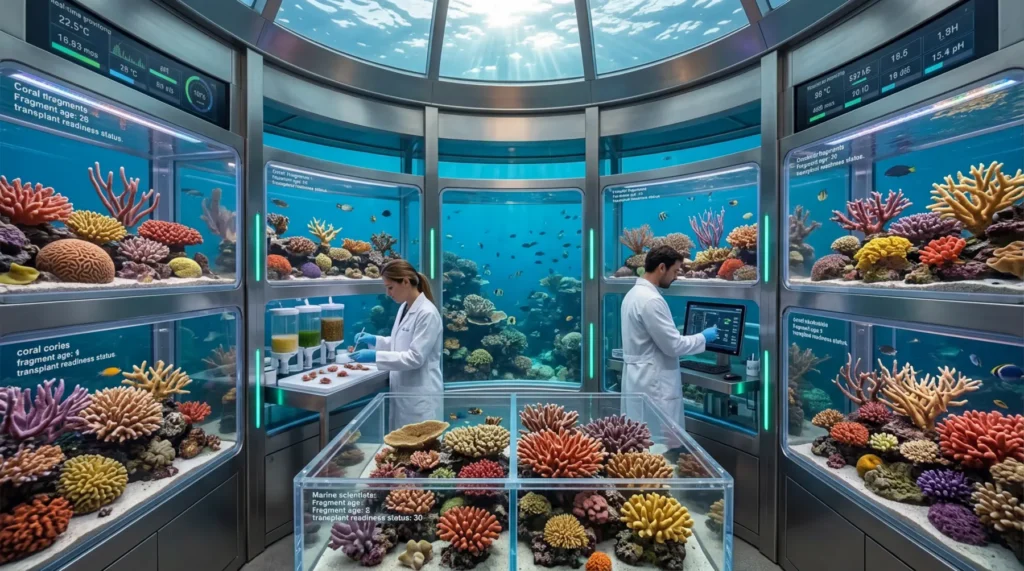
Conservation: A dedicated coral restoration dome exists on-site. Thousands of coral fragments at different growth stages. Hard corals, soft corals, endemic Raja Ampat species. Real-time monitoring: temperature, pH, light, nutrient levels.
Every fragment that reaches transplant-ready status (12-18 months typically) gets outplanted onto damaged reef sections in Raja Ampat. We verified the targets with three independent marine conservation organizations: 2,000+ fragments transplanted annually by Year 5.
Over 10 years, this will contribute to healing roughly 15 hectares of damaged reef. That’s a concrete number. Not marketing. Not promise. Measurable impact.
The Economics
A week costs USD20,000 to 35,000 depending on the chosen package and season.
That money funds:
- Coral cultivation and transplantation
- Marine scientists and staff
- Reef monitoring systems
- Local partnerships in Raja Ampat
This isn’t a luxury resort with a conservation side project. It’s the other way around: a conservation operation that is also luxurious. The luxury pays for the science. That’s the entire model.
THE DEVELOPER’S VISION
Who’s Building This?
The mastermind behind The Dome remains intentionally low-profile, a marine architect and conservationist who has spent 15 years designing sustainable underwater structures across Southeast Asia. We were able to ask a few questions before they returned to focus on final construction details.
From the Developer
On the concept
“The reef doesn’t need more observation platforms. It needs healing. The real challenge was: how do you design a space that’s luxurious enough to fund the conservation work, transparent enough that people understand what they’re part of, and rigorous enough to actually restore damaged ecosystems? Show them the work. Make them part of it. Glass between comfort and conservation—nothing hidden.”
On Raja Ampat
“It has the world’s highest marine biodiversity. It also has heavily damaged reef sections from fishing pressure and warming. Highest stakes, highest biodiversity, and a community committed to restoration. The water clarity and current patterns also work for the tidal energy.”
On timing:
“Soft opening April 1st, 2027. Phase one establishes coral restoration protocols with our scientific partners. Full operation by second half of 2027. Every phase is led by what the reef needs, not what’s convenient for the development schedule.”
On partnerships:
“We’re finalizing partnerships with three major research institutions and two conservation NGOs. Each will have embedded scientists on-site. Guests aren’t tourists, they’re citizen scientists supporting reef restoration. That’s the model.”
WHAT’S INCLUDED
Diving & Exploration
- Daily guided dives to Raja Ampat sites (Misool, Dampier Strait, Penemu)
- Dives focusing on endemic species and restoration outplants
- Option to participate in coral fragment preparation and transplanting
- Snorkeling, macro photography, night diving
- Dive briefings with marine scientists
- Partnership with Raja Ampat dive resorts and accommodations
Accommodation
- Private suite dome (bedroom, bathroom, living area)
- Integrated en-suite diving pod (direct reef access)
- Floor-to-ceiling transparent dome walls (360° ocean views)
- Sustainable materials (teak, titanium, recycled composites)
- Temperature and light controlled (optimized for comfort and reef observation)
Meals & Hospitality
- Fine dining in the central restaurant dome (French-Indonesian fusion)
- Breakfast, lunch, snacks prepared fresh daily
- Bar service with Australian and French wine selections
- Special dietary requirements accommodated
Activities & Learning
- Daily guided dives (2-3 per day typical)
- Coral nursery lab visits (see restoration in real-time)
- Guest participation in coral fragment preparation
- Marine science seminars (species identification, reef ecology, conservation)
- Reef health monitoring (learn data collection methods)
- Night snorkeling and bioluminescent observation
- Photography workshops and gear optimization
- Biosphere system education (how algae-based air purification works)
WHAT YOU’RE ACTUALLY SUPPORTING
Every booking directly funds:
Coral Restoration Program
- 2,000+ coral fragments cultivated and transplanted annually
- Focus on endemic Raja Ampat species
- Monitoring over 12-18 months post-transplant
Research Partnerships
- Embedded marine scientists from partner institutions
- Real-time reef health data collection
- Species documentation and behavioral studies
- Student research internships
Local Community
- Employment for local dive guides and technicians
- Training in reef restoration and monitoring
- Revenue sharing from guest bookings
- Infrastructure development benefiting the broader Raja Ampat region
THE REAL IMPACT
Raja Ampat has lost 30% of its coral cover in 15 years. Warming, fishing pressure, coastal pressure. The reef is resilient but it also needs help.
One sanctuary can’t fix the whole system. One project can’t reverse warming. But 2,000+ coral fragments transplanted annually is concrete. That’s recovery in specific areas. That’s a pattern other conservation projects can copy.
We’re sharing this because it might work, not because it looks spectacular.
THE REEF DOESN’T WAIT FOR 2027
Twenty meters below Raja Ampat, restoration is happening now. The Dome is real. The timeline is April 2027. And it will change how underwater travel works.
But the reef doesn’t wait. The work, coral cultivation, species monitoring, ecosystem recovery, happens today. Every expedition we run, every dive we guide directly funds this mission.
SIGN UP TO FOLLOW THE DEVELOPMENT AND EARLY BIRD BOOKINGS
👉 Book The Dome: Click here or Sign up below for announcements and early access.


DIVING NOW: CURRENT EXPEDITIONS
While The Dome launches in 2027, Raja Ampat has dive options available today. Same mission, immediate impact.
A Note on The Dome (And What We Actually Offer)
The Dome Raja Ampat is fictional. We published it on April 1st as an April Fools’ joke, to have fun, see how people would react, and spark a conversation. It worked.
People reached out asking if it was real. Some were genuinely intrigued. Others questioned the sustainability angle. Which is fair. Because let’s be honest: building a giant artificial structure on a coral reef isn’t sustainable.
It’s the opposite. It’s extractive, it’s invasive, it’s a fantasy that sounds good until you think about what it actually does to the ecosystem. That’s partly why we built it as fiction to highlight the absurdity of calling that “sustainable.”
Real sustainability doesn’t mean luxury domes. It means working with the reef, not against it. We partner with sustainable operators and local conservation NGOs. We run trips focused on reef restoration and environmental impact. When you dive with us, you’re not building artificial structures, you’re participating in actual, measurable conservation. No domes. No fantasy. Just real work on real reefs.
Ready to explore what sustainable diving actually looks like?
Get in touch with our diving and adventure travel expert and let’s start designing the real sustainable trip of your dreams.