
Short answer: no, most travelers do not need a doctor’s note. You do need to complete the RSTC Diver Medical Participant Questionnaire on arrival (every reputable Indonesian operator asks for it). If your honest answers flag any of the conditions on the form, a doctor’s signature is then required before you can dive. If they do not, no medical visit is needed. Most travelers can settle this in two minutes online.
This guide walks through exactly what dive operators ask, what conditions need a doctor’s clearance, and how to get sorted before you land. There’s also a free online version of the same questionnaire at the bottom that you can fill in now and bring (or email) to your doctor and dive center.
The form Indonesian dive operators use is the RSTC 2022 questionnaire
The form is the Diver Medical Participant Questionnaire, version 2022-02-01, created by the Diver Medical Screen Committee in association with the Undersea & Hyperbaric Medical Society (UHMS), DAN US, DAN Europe, and UCSD’s Hyperbaric Medicine Division. PADI, SSI, RAID, SDI and the other major training agencies all align on this same form. That means you’ll see the same 10 questions on arrival whether you’re learning to dive in Amed, joining a Komodo liveaboard, or signing up for a Penida day trip.
The questionnaire has two parts:
- Part 1: 10 general screening questions. If you answer No to all 10, no medical evaluation is required. You sign the participant statement and dive.
- Part 2: conditional follow-up boxes (A through G). Each Yes in Part 1 opens a follow-up box with more specific questions (chest surgery, asthma, heart conditions, neurological issues, etc.). Any Yes in those follow-ups triggers the requirement to see a physician before diving.
If you take it to your doctor, the form has a page 3 specifically for them: the Diver Medical Physician’s Evaluation Form. They sign Approved or Not Approved, you bring the signed form to your dive operator, and you’re cleared.
When does diving in Indonesia actually require a doctor’s signature?
You need a doctor’s clearance if you answer Yes to any of the 10 Part 1 questions or to any of the follow-up questions in Boxes A through G. In plain language, the form flags the following groups of conditions:
- Heart and circulatory: heart attack, heart surgery, pacemaker, valve disease, heart failure, ongoing heart medication, chest pain on exertion, angina, recent stroke
- Lungs and breathing: chronic lung disease, pneumothorax, recurrent bronchitis, emphysema, asthma or wheezing in the last 12 months
- Age 45+: automatically triggers a short cardiovascular risk box (smoking, blood pressure, cholesterol, family history of early cardiac events)
- Ears, sinuses, eyes: recent sinus or eye surgery, ear disease, hearing loss, balance problems, recurrent sinusitis
- Neurological: head injury with loss of consciousness in the last 5 years, persistent neurological disease, epilepsy, recurrent migraines, fainting episodes
- Mental health and addiction: ongoing treatment for major depression, bipolar disorder, panic disorder, addiction treatment in the last 5 years, learning or developmental disorders requiring care
- Back, hernia, ulcers, diabetes: recent back surgery, uncorrected hernia, active or recently-treated ulcers, ostomy without medical clearance to swim, diabetes (drug or diet-controlled)
- Digestive: active ulcers, GERD, ulcerative colitis or Crohn’s disease, bariatric surgery in the last 12 months
- Surgery and medication: any surgery in the last 12 months, ongoing surgical complications, prescription medication (except birth control and most anti-malarials)
- Pregnancy: diving is not recommended at any stage of pregnancy
This isn’t an exhaustive list of every contraindication; it’s the screening trigger list. A dive doctor may clear you with conditions that look concerning on paper (well-controlled asthma, stable diabetes, healed surgery) and may decline conditions that look mild (unstable blood sugar, recent equalization issues). The point of the screening is to route the call to the right person, not to make it.

Why see a dive doctor instead of a regular GP?
Because pressure physiology isn’t standard medical training, a GP may either over-restrict (refusing safe divers) or under-restrict (clearing risky cases) without realizing the trade-offs.
A dive doctor knows the specific way pressure changes interact with each system: how lung overexpansion can cause arterial gas embolism, why poorly controlled asthma matters underwater more than on land, how nitrogen loading interacts with various medications. Their evaluation usually takes 15-30 minutes and a short respiratory function test. In countries with active dive medicine programs (UK, France, Germany, the US, Australia), finding one is usually a Google search away. DAN World maintains a list of dive doctors by region; in France, look for the médecin fédéral FFESSM or médecin du sport with dive experience.
If you can’t find a dive doctor and have to use a GP, bring the full RSTC PDF (all 3 pages, including the Physician’s Evaluation Form on page 3). It guides them through the relevant assessment and gives them a structured form to sign rather than a blank prescription pad.
When should I get this sorted relative to my trip?
Two to four weeks before departure is the practical window. That gives your doctor time to order a respiratory function test or other workup if needed, you time to receive a signed clearance, and your dive operator time to confirm everything is in order before your first dive day.
If you’re under 45, have no chronic conditions, take no medication, and are reasonably active, you’ll almost certainly screen clean and won’t need a doctor’s visit at all. Most travelers fall into this bucket. If you have any of the conditions in the list above, build a doctor visit into your pre-trip checklist as early as you can, especially if you may need a respiratory function test that takes a few days to schedule.
Two specific edge cases worth flagging:
- You get a cold or sinus infection close to departure. This is a temporary contraindication, not a clearance issue. Wait until you can equalize fully before diving. A signed clearance from your GP can’t override blocked sinuses on the day.
- You’re between training agencies. The RSTC form is recognized across PADI, SSI, RAID, SDI and most others, so a clearance issued for one is honored by the others. You don’t need to redo it if you certified PADI and now you’re doing SSI fun dives.
Free online tool: take the screening now
Ocean Earth Travels maintains a free, anonymous online version of the same RSTC 2022 questionnaire at oceanearthtravels.com/scuba-diving/medical-questionnaire. It walks you through one question at a time, applies the same logic dive operators apply on arrival, and gives you a clear result at the end (cleared, or physician evaluation recommended).
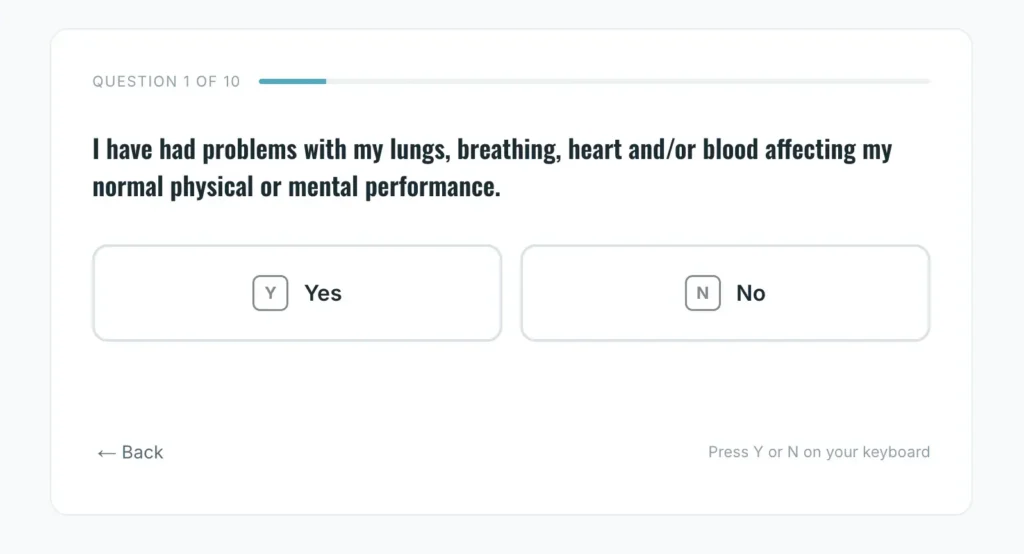
If your answers say a doctor’s evaluation is recommended, the tool also generates a 3-page PDF that includes:
- Your answers to all the questions, written in
- The same Physician’s Evaluation Form (page 3 of the RSTC) ready for your doctor’s signature
- A reference to the official RSTC source documents
You hand the PDF to your doctor at the appointment. They evaluate, sign or decline, you bring the same PDF to your dive shop in Indonesia. One document, no rewriting, no chasing forms across continents.
→ Take the 2-minute fit-to-dive screening
Frequently asked questions
Do I need a dive medical certificate to dive in Bali?
Not by default. You need to complete the RSTC Diver Medical Participant Questionnaire, which is the same in Bali as anywhere else in Indonesia. If all your answers are No, no doctor’s visit is required. If any are Yes, you’ll need a doctor’s signature before diving. Dive shops in Bali (Amed, Tulamben, Sanur, Padangbai, Pemuteran, Menjangan) all use this same form.
Can I dive in Indonesia with asthma?
Often yes, with a dive doctor’s clearance. Well-controlled asthma in someone with normal respiratory function and no recent attacks is frequently cleared. Active wheezing or recent attacks within the last 12 months are flagged for evaluation. The dive doctor will assess your specific case, often using a respiratory function test.
Can I dive in Indonesia with diabetes?
Often yes, if your diabetes is stable and well-managed. The RSTC form flags diabetes (drug or diet-controlled) for medical evaluation. A dive doctor typically clears Type 1 and Type 2 divers who have HbA1c in target range, no recent severe hypos, and a clear management plan for diving days. Brittle or poorly-controlled diabetes generally won’t clear.
Can I dive while pregnant?
No. Diving is not recommended at any stage of pregnancy. Most agencies will decline to train pregnant divers, and the RSTC form lists pregnancy as a direct contraindication. Surface snorkeling carries no comparable risk. This is the only condition on the form that’s an outright “no” rather than “see your doctor first”.
I’m over 45. Do I automatically need a medical?
Not automatically. Being over 45 opens Box B on the RSTC form, which adds 4 cardiovascular risk questions: smoking, high cholesterol, high blood pressure, and family history of early cardiac events. Only if you answer Yes to any of those does the medical evaluation become required. Many people over 45 with no flagged risk factors complete the form with all No answers and dive without a doctor’s signature.
Is the clearance valid forever, or do I need to redo it?
The form is a point-in-time screen, not a license. Most operators ask you to complete it again before each new course or trip if more than 12 months has passed, or if your health status has changed since the last one. If you got cleared with asthma three years ago and now you have hypertension, that’s a new screening and possibly a new doctor visit.
What’s the difference between the OET fit-to-dive tool and the official RSTC PDF?
Same form, same logic, different format. The official PDF is a printable 3-page document; you fill it in by hand or PDF reader. The OET tool walks you through it one question at a time on your phone or laptop, generates a personalized PDF you can email straight to your doctor or dive shop, and includes the same Physician’s Evaluation page for the doctor’s signature. The OET tool also flags exactly which conditions you ticked, so the doctor knows where to focus their evaluation.
Bottom line
For most travelers, fitness to dive in Indonesia is a 2-minute online screening that returns “cleared, no medical needed”. For those with conditions that flag, it’s a 30-minute doctor visit at home before the trip, not a stressful surprise on arrival. The form is standard, the trigger conditions are public, and the logic is the same at every reputable operator in the country.
If you’re traveling within the next few months and haven’t run the screen yet, take the OET tool now: oceanearthtravels.com/scuba-diving/medical-questionnaire. Two minutes, no email needed to see your result, optional PDF download for the doctor visit if needed.
Once you’re cleared, our team is happy to help you build a trip around it. Contact us for a custom itinerary suited to your certification level and time of year.