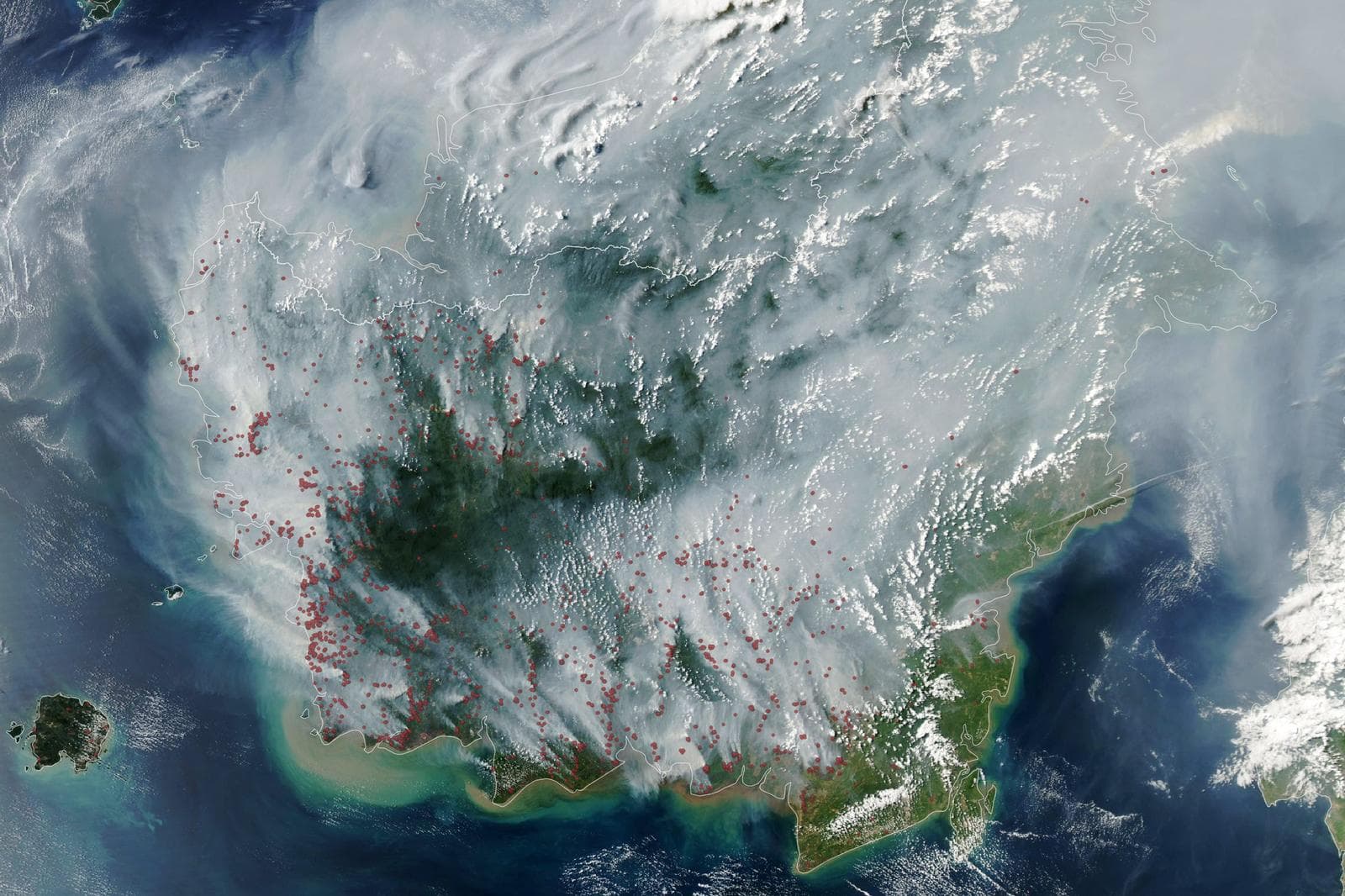
We are often asked whether Borneo is on fire. Most years the answer is yes, somewhere, but nowhere near where you are going. 2026 is different. Indonesian authorities call it the worst fire season in 11 years, and the smoke has not stayed in Kalimantan. It has crossed into Malaysia and drifted over the sea to Singapore. For much of the past month, IQAir has ranked Kuching, Kuala Lumpur and Singapore among the most polluted major cities in the world.
The Tanjung Puting fires are part of that picture, but a small part of it. Our local team works on the Sekonyer River every week, and we have had guests on the boats through August and September. So this is less a news round-up than a field report: how big the fires are, where they are worst, and what people on the river are actually seeing. Everything below carries a date, because the situation changes week to week.
How big the 2026 fire season is
Borneo is the third-largest island in the world, about 743,000 square kilometres, shared by Indonesia, Malaysia and Brunei. Kalimantan, the Indonesian part, covers roughly 73 percent of it.
Across Indonesia, fires burned 1,358,714 hectares between 1 January and 31 August, according to figures compiled by IQAir. That is more than twice the size of Bali. About 1.32 million hectares of it burned in August alone, and roughly 447,600 hectares was peatland.
The emissions tell the same story. In the first week of September, Indonesia released 19.7 million tonnes of fire emissions. That was more than any other country that week, and over a third of the world’s total.
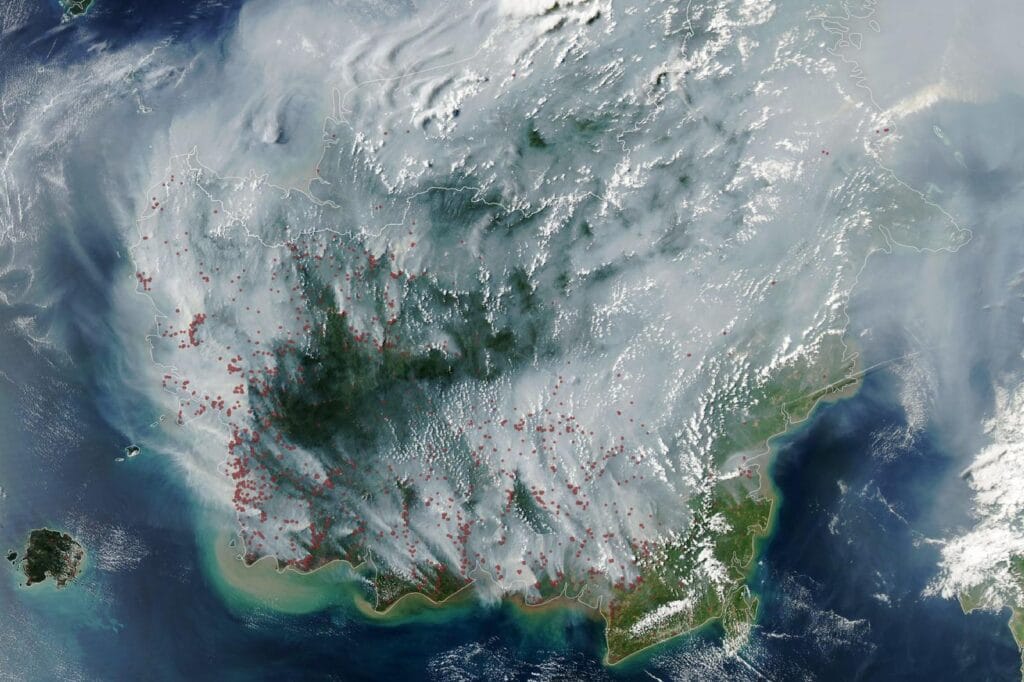
If you want to watch the fires yourself, NASA’s FIRMS map shows satellite fire detections worldwide, updated several times a day. Zoom in on southern Borneo. One caution from NASA itself: satellites struggle to see fires through thick smoke or underground in peat, so the worst days can show fewer dots, not more.
Why 2026 is so dry
The short answer is El Niño. NOAA assessed it as present and strengthening in August, and it arrived alongside a positive Indian Ocean Dipole, a second pattern that also cuts rainfall over Indonesia. Together they left about 90 percent of the country with little or no rain in early August. The last seasons like this were 1997 and 2015, the two worst fire years in recent memory.
The forecast does not help. Indonesia’s weather agency, BMKG, expects El Niño to last into early 2027. Rain usually ends the fire season in October or November, and this year it may come late.
Drought sets the conditions. The fires themselves are almost always started by people, usually to clear land, according to research on past seasons.
Why peat fires are so hard to put out
Much of what burns in Kalimantan is peat: dead plant matter piled up over thousands of years, in places more than ten metres deep. Wet, it will not burn. Drained and dried, it smoulders underground, creeping a few centimetres a day beneath ground that looks fine. Water from a hose wets the top layer while the fire carries on below. That is why peat fires usually end when the rains raise the water table, not when fire crews arrive.
Peat smoke is also far dirtier than smoke from a normal forest fire. NASA cites estimates of three times more fine particulate matter and five times more sulphur dioxide. So an area can have almost no visible flame and still produce weeks of heavy haze. It works the other way too. A smoky sky over a town tells you there is fire somewhere upwind. It does not tell you the forest around you is burning.
Where the fires are worst
West Kalimantan has the largest burned area of any province this year, followed by Central Kalimantan and South Papua. Central Kalimantan, where Tanjung Puting sits, has had the most active fires in September. On 11 September it recorded 271 of the country’s 688 high-confidence hotspots.
The worst air has been in the middle and east of the province. Readings on Indonesia’s ISPU scale reached 700 to 780 in Palangkaraya, the provincial capital, and 1,166 in Sampit. Anything above 300 counts as hazardous. Neither town is on the way to Tanjung Puting, which starts from Pangkalan Bun airport in the west of the province.
Closer to the park, the picture is mixed. Kotawaringin Barat, the regency that holds Pangkalan Bun and the port of Kumai, reported 859 hectares burned by 18 August. Most of that, 584 hectares, was in Kumai sub-district. The regency extended its fire emergency status. It also sits inside Central Kalimantan’s provincial emergency alert, which runs to 31 October. At 1 pm on 28 September, IQAir’s satellite-based reading for Kotawaringin was 164 on the US AQI. IQAir classes that as unhealthy, and its forecast eased through the afternoon.
What the Tanjung Puting fires mean for the park
On 9 September the park authority put the burned area inside Tanjung Puting at 3,105 hectares. It covers three areas, Sungai Cabang (about 1,114 hectares), Teluk Pulai (about 1,062) and Sungai Perlu (about 930). The park covers roughly 415,000 hectares, so that is under one percent of it.
The park authority’s update of 9 September, based on monitoring with Orangutan Foundation International, said the orangutans were safe. It put the nearest fire around the mouth of the Sekonyer River, about five kilometres from the feeding area that is the orangutans’ main habitat. It said the fires had not yet had much direct effect on that habitat. The mouth of the Sekonyer is where boats from Kumai enter the river. Local tour operators lent klotoks to the fire crews as field kitchens.
Tanjung Puting has not been closed. On 31 August the Forestry Ministry closed the hiking routes in nine national parks at high fire risk: Bromo Tengger Semeru, Kerinci Seblat, Gunung Ciremai, Tambora, Manusela, Bukit Baka Bukit Raya, Gunung Gede Pangrango, Gunung Leuser and parts of Lorentz, according to Antara. Tanjung Puting was not on the list. Our team in Kumai told us on 25 September that neither the local government nor the park had issued any advisory. You may see posts online saying otherwise, so check them against the ministry’s list.
What our guests and guides are seeing
The most useful information on the Tanjung Puting fires comes from people on the river.
On 27 August, our partner team in Kumai told us visibility in the park was fine and that morning’s flight had landed on time. By 4 September smoke had reached Tanjung Puting, but mostly in the mornings. It usually cleared by late morning and was nowhere near as thick as in Palangkaraya.
Mathieu travelled with two friends on a private klotok from 2 to 4 September. Their flight from Jakarta could not land at Pangkalan Bun because of poor visibility and was diverted to Semarang. They took off again at 9:30 the same morning and were on the boat by lunchtime. This is what he sent us when he got back:
Everything was perfect. We saw orangutans, gibbons, a crocodile, proboscis monkeys, and fireflies. The meals and the onboard staff were simply perfect. There is nothing to complain about, everything was perfect.
Terima kasih,
– Mathieu
Our most recent guests travelled from 25 to 27 September. They flew in from Surabaya, visited the feeding stations and added a jungle trek at Camp Leakey.
The wildlife is still there
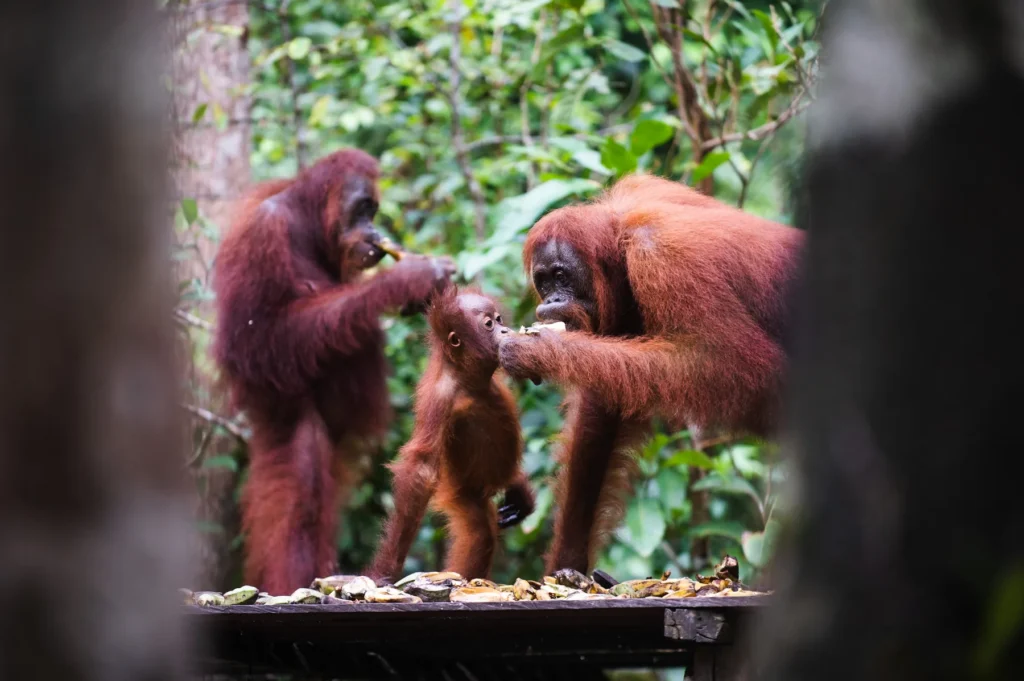
This is why people come to Tanjung Puting, and it has not changed. Orangutans still come to the feeding platforms at Tanjung Harapan, Pondok Tanggui and Camp Leakey on most days. They are wild, so no single feeding is certain. Along the Sekonyer, proboscis monkeys settle into the riverside trees in the late afternoon. Gibbons call from the canopy and crocodiles lie on the banks. After dark, fireflies light up the trees along the river. Mathieu’s group saw all of that on a single three-day trip in September, in the middle of the Tanjung Puting fires.
The timing works in your favour. The feedings at Camp Leakey (2 pm) and Tanjung Harapan (3 pm) fall well after the morning haze usually lifts. You spend most of the trip on the water and in the forest, far from the towns where the air is worst.
Flights are running, but not every day. On Sunday 27 September, nine arrivals were scheduled into Pangkalan Bun from Jakarta, Surabaya and Semarang on Batik Air and Nam Air. One early Nam Air flight from Jakarta was cancelled, and both Batik Air flights from Jakarta arrived on time. The next day was worse. On Monday 28 September Batik Air cancelled all three of its departures from Pangkalan Bun, to Jakarta, Surabaya and Semarang, after smoke cut visibility at the airport to 1,200 metres, according to Radar Sampit.
Smoke can close the airport for a morning, as it did for Mathieu on 2 September, or for a whole day, as on 28 September. Early flights are the most exposed, because haze is thickest at dawn. Leave some slack: fly in the day before if you can, and do not book a tight onward connection on your last day. On a private trip our guides reshuffle the feeding station visits around a late arrival.
The orangutans across Kalimantan
The worst confirmed harm to orangutans this year is in West Kalimantan, not Tanjung Puting. By 5 September, AFP reported, nine orangutans had been evacuated from fire zones in the Ketapang district in less than a month, including two mothers with babies. One died after rescue, and a necropsy pointed to smoke. IFAW reported 19 orangutans and 12 other animals evacuated in the province. On 15 September Antara reported three more fire-affected orangutans rescued there. The Guardian reported fires threatening Cabang Panti in Gunung Palung, one of the longest-running orangutan research sites anywhere.
We have found no confirmed orangutan death inside Tanjung Puting.
The longer damage is to habitat. The campaign group Geopix counted 22,744 fire hotspots across Kalimantan between June and August, using government data. Of those, 17,865, or 78.5 percent, were inside orangutan habitat, Down To Earth reported.
Orangutans breed only once every seven or eight years, the longest gap between births of any land mammal. That is one of the stranger facts about how they live. The Bornean orangutan is already critically endangered. A fire does not have to kill them to hurt them. Burned peat forest takes decades to grow back, and the first plants to return are rarely the fruit trees orangutans eat.
What the government is doing
The government has put six provinces at the top of its firefighting list, including Central and West Kalimantan. It has staged 53 aircraft for water bombing, air patrols and cloud seeding. Japan sent three Chinook helicopters and about 180 personnel to West Kalimantan, Reuters reported.
On enforcement, the Forestry Ministry has frozen the licences of 26 companies. On 22 September it revoked five forestry concession licences across West, Central and South Kalimantan, saying the holders had failed to protect their land from fire. The Forestry Minister, Raja Juli Antoni, said enforcement must apply “to those at the top” as well as at the grassroots, in line with President Prabowo Subianto’s instructions.
Peat firefighting is slow. The ministry has warned that underground fires can flare up again after the smoke clears, and it has asked people to stay alert until early November.
Planning a trip this season
The Tanjung Puting fires have not stopped the trips, but they do change how we plan them. We run klotok trips here, so read this with that in mind. What we can offer is what our team on the river sees, with dates.
Start with the air. IQAir’s live reading for Kotawaringin covers the area around Pangkalan Bun. If it sits in the hazardous range for the week you plan to travel, postpone. If you have asthma or a heart or lung condition, or you are bringing young children, talk to your doctor before you book. Pack well-fitted N95 or KN95 masks for the mornings and the airport.
Then build in flexibility. Choose a later flight in, or arrive the night before. Keep your plans loose on the last day. If the numbers turn bad close to your dates, moving the trip to later in the season keeps the money with the crews in Kumai rather than pulling it out.

Our team in Kumai keeps us posted as each group goes out. Send us your dates and we will reply with the latest ground report: the air, the flights and what our last guests saw on the river. If the week looks bad, we will say so and help you move the trip. You can see what a typical three or four days looks like on our Tanjung Puting orangutan tour page, and the rest of the island on our Borneo guide.
How to help
Appeals open and close, so check the current position on each organisation’s own site before you give.
Orangutan Foundation International, founded by Birute Galdikas, works in and around Tanjung Puting and has a published appeal funding rescue and firefighting teams this season. Of the orangutan organisations, its work sits closest to the park this article is about.
The Borneo Orangutan Survival Foundation runs fire preparedness and response elsewhere in Central Kalimantan, and has posted updates as fire reached the Mawas Conservation Area.
The Orangutan Republik Foundation has an Emergency Fire Appeal that funds partner organisations across West, Central and East Kalimantan. It is small and it publishes its running totals, which we like.
The simplest support for local families is money spent locally, with guides, boat crews and homestays, during a season when visitors are scarce.
Frequently asked questions
Yes. The park authority reported 3,105 hectares burned inside the park as of 9 September 2026, in the Sungai Cabang, Teluk Pulai and Sungai Perlu areas. That is under one percent of a park of about 415,000 hectares. Crews were still fighting the fires in mid-September.
Yes. Tanjung Puting was not among the nine national parks whose hiking routes the Forestry Ministry closed on 31 August 2026, and on 25 September our team in Kumai reported no advisory from the park or the local government. Boats are running, and our guests travelled through August and September. Parks can close sections at short notice in fire season, so ask us for the latest before you travel.
As of 9 September, the park authority and Orangutan Foundation International said the orangutans were safe. The nearest fire was around the mouth of the Sekonyer River, about five kilometres from the feeding area, and had not yet had much direct effect on their habitat. We have found no confirmed orangutan death inside Tanjung Puting. The confirmed rescues, and one death linked to smoke, were in West Kalimantan.
Yes, and guests are doing so. Our most recent group travelled from 25 to 27 September. Whether you should go depends on the air and the flights in your week. Check IQAir’s reading for Kotawaringin, leave slack for flight delays, and ask us for a current ground report before you book or cancel.
We sell these trips, so weigh our answer with that in mind. Cancelling does not put out a peat fire or restore burned forest, and it takes income from guides, boat crews and homestay families already living in the haze. It is the right call if the air is hazardous in your week or if you have a heart or lung condition. Postponing rather than cancelling keeps the money local. Get the current conditions first, then decide.
On some days, yes. On 2 September a flight from Jakarta could not land and was diverted to Semarang, then reached Pangkalan Bun later that morning. On 28 September Batik Air cancelled all three of its departures from Pangkalan Bun when smoke cut visibility at the airport to 1,200 metres. On other days flights ran on time. Early flights are the most exposed, so fly in the day before or take a later flight, and avoid a tight connection on your last day.
Peat is thousands of years of undecomposed plant matter, in places more than ten metres deep. Once drainage canals dry it out it smoulders rather than burns, creeping underground at a few centimetres a day. Water and rain wet only the top layer while the fire continues below, so a peat fire usually ends when the water table rises in the wet season, not when crews reach it. Smouldering also produces far more smoke per kilo of fuel than open flame, which is why haze persists with little visible fire.
Give to an organisation with a published fire response you can verify. Orangutan Foundation International works in and around Tanjung Puting, the Borneo Orangutan Survival Foundation is running fire response in Central Kalimantan, and the Orangutan Republik Foundation has an active Emergency Fire Appeal covering partners in West, Central and East Kalimantan. Check each appeal on the organisation’s own site, since they open and close. Postponing a trip rather than cancelling it also keeps income with local crews.