
Every guide to Kakaban Lake says its jellyfish don’t sting. That is almost true. The jellyfish in this lake on Kakaban Island, in the Derawan Islands of East Borneo, still carry stinging cells. After thousands of years cut off from the sea, their stings are so weak that most swimmers never feel them.
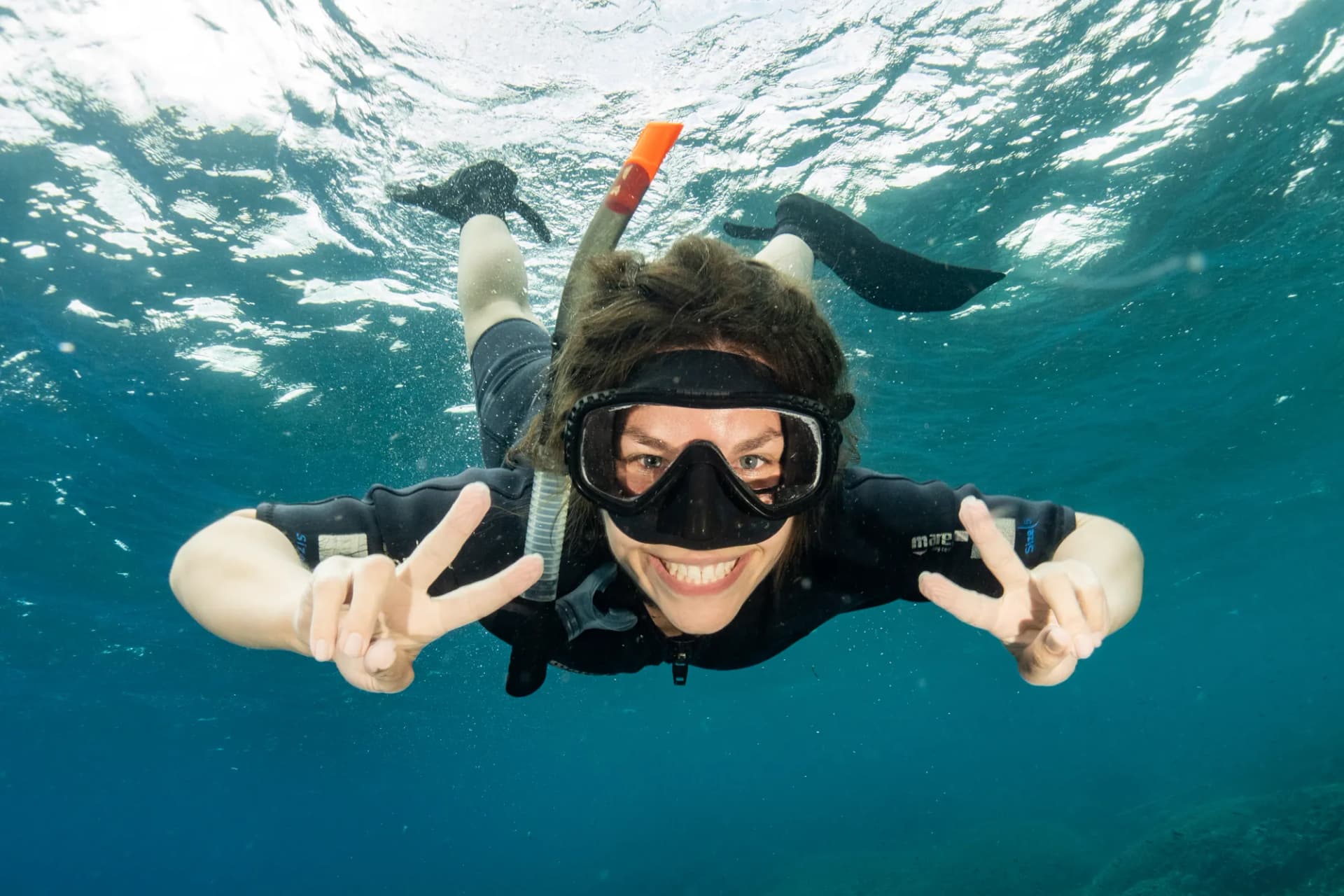
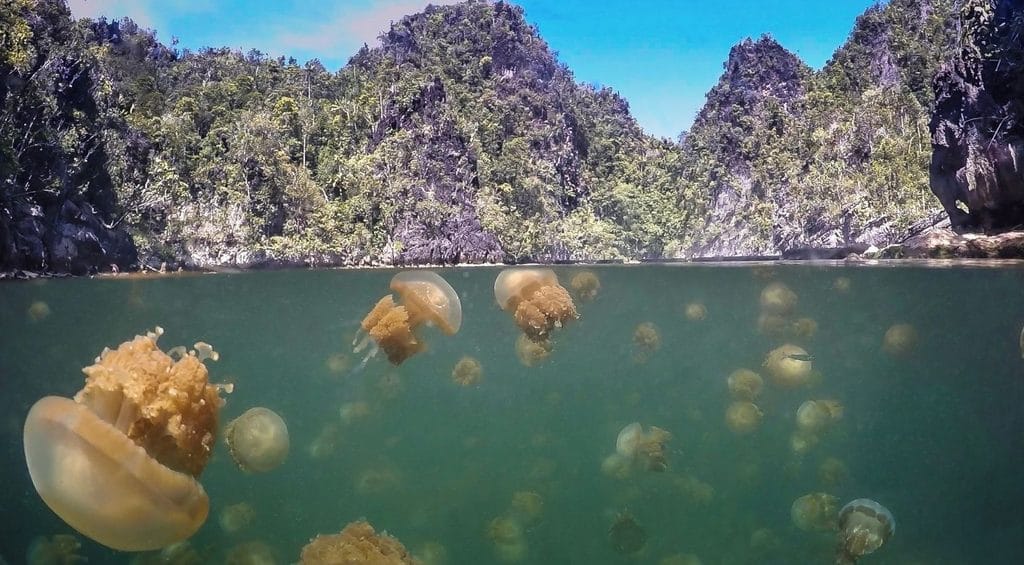
So you slip in with a mask and snorkel, and the green water fills with gold. Thousands of jellyfish pulse up toward the light. They bump softly against your mask and arms, and you feel nothing at all.
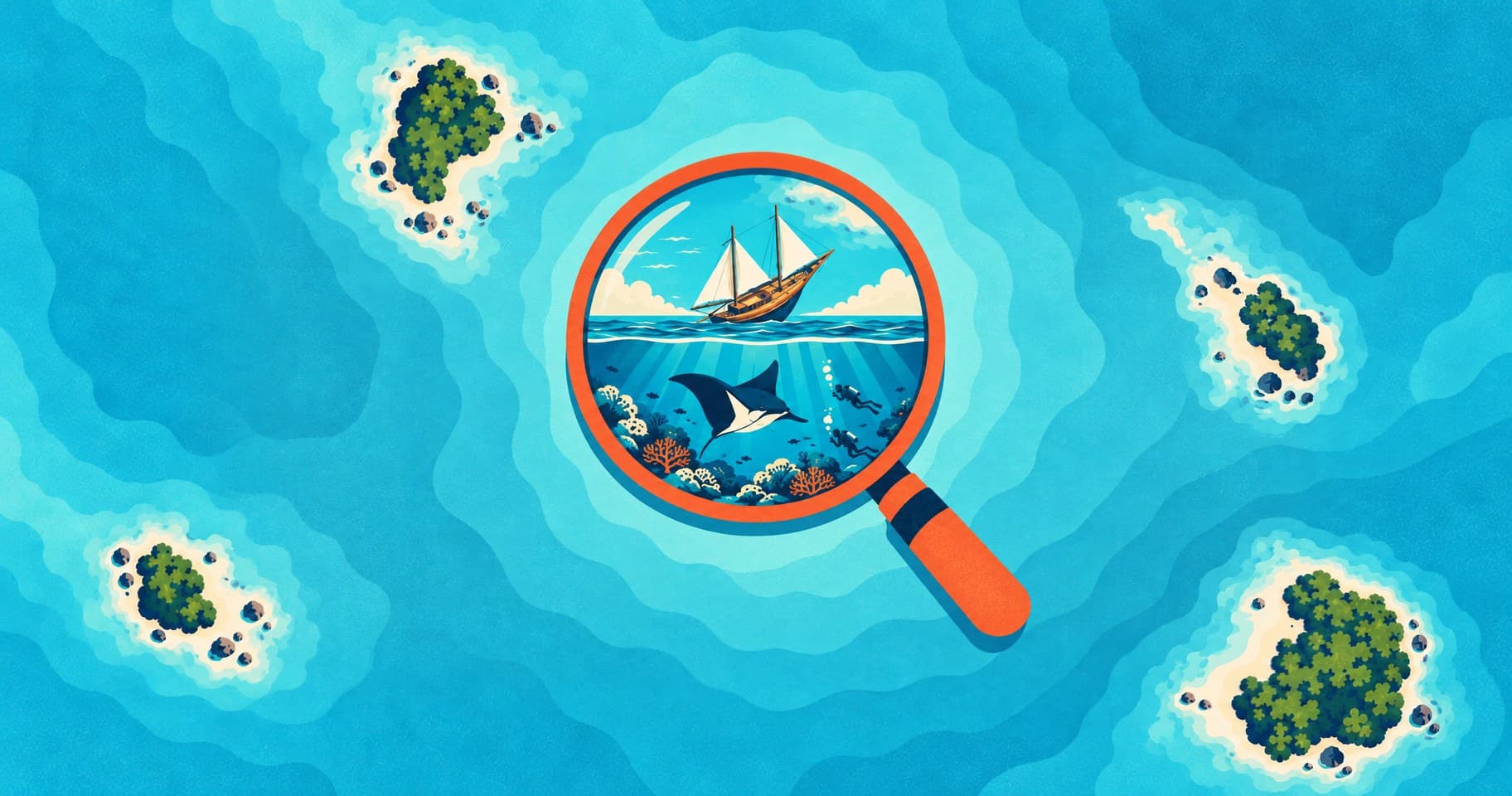
We plan trips across the Derawan Islands, and the lake is part of almost every one. Below you’ll find how it formed, why its jellyfish changed, the four other jellyfish lakes in Indonesia, and a five-night plan you can copy.
Kakaban Lake at a glance
- Where: Kakaban Island, Derawan Islands, Berau, East Kalimantan
- What: a brackish lake inside a raised coral island, with four jellyfish species
- Depth: up to 17 metres, with low visibility
- How you visit: snorkelling only, no scuba
- Best season: April to November, when the sea crossings are calmest
- Next door: Barracuda Point, an advanced wall dive about five minutes away
Where is the Kakaban jellyfish lake?
Kakaban is one of the four main Derawan islands, with Derawan, Sangalaki and Maratua. They lie off the coast of Berau, in the north of East Kalimantan. Kakaban looks the wildest of the four. Limestone cliffs drop straight into the sea and jungle runs to the water’s edge. The lake fills the middle of the island, about five minutes’ walk from the jetty.
How did a lake end up inside an island?
Kakaban is a raised atoll. A ring of coral reef once grew around a shallow lagoon. Then movements in the Earth’s crust lifted the whole reef above sea level. Thousands of years ago, the old lagoon became a lake inside a limestone rim.
The lake is not completely cut off. Seawater seeps in through cracks and tunnels in the rock, and rain freshens the surface. That makes the water brackish: saltier than a river, less salty than the sea. Scientists call this an anchialine lake, with a hidden link to the sea below ground.
The floor is carpeted with Halimeda, a green seaweed made of small coin-shaped segments. When Tomascik and Mah published the first detailed study of the lake in 1994, they called it “Halimeda Lagoon”.
Do the jellyfish in Kakaban Lake sting?
Barely. Jellyfish use their stinging cells to catch food and defend themselves. In the open sea both jobs matter. In a lake with very few animals that hunt jellyfish, a strong sting brings little benefit.
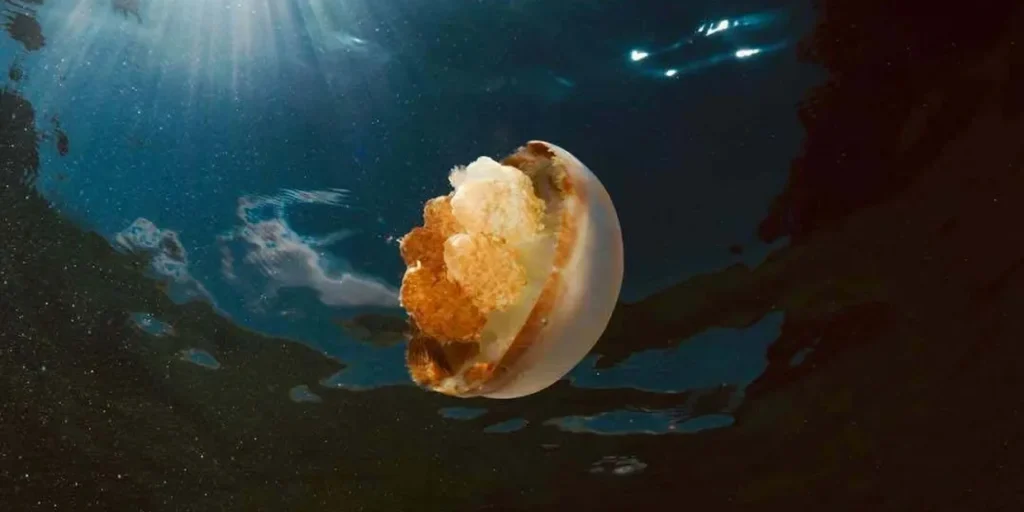
Food explains the rest. The golden and upside-down jellyfish carry tiny algae inside their bodies. The algae turn sunlight into sugar and share it with their host, so the jellyfish hunt less. Jellyfish trapped in lakes can also change fast. In 2005, Michael Dawson and William Hamner showed in PNAS that golden jellyfish in Palau’s marine lakes changed shape and behaviour quickly after the lakes closed off.
Thin skin around the lips or eyes can feel a faint tingle. If you react strongly to jellyfish elsewhere, wear a rash vest and keep your mask on.
Which jellyfish live in Kakaban Lake?
| Jellyfish | Scientific name | How to spot it |
|---|---|---|
| Golden jellyfish | Mastigias papua | Round, golden-brown bell, up to fist size. The most common, often in dense groups near the surface |
| Moon jellyfish | Aurelia aurita | Clear, flat bell with four pale horseshoe shapes in the centre |
| Upside-down jellyfish | Cassiopea ornata | Lies on the floor with its arms pointing up, so it looks like a plant |
| Box jellyfish | Tripedalia cystophora | About 1 cm, with a square bell. Look in the light between the mangrove roots |
Can you find the box jellyfish? It’s the one most people miss. Its relatives in northern Australia are among the most dangerous animals in the sea, but this one is no bigger than a fingertip and harmless to swimmers. It has 24 eyes in four clusters, and it uses them to steer between the roots where it hunts.
What else lives in the lake?
Look past the jellyfish and the mangrove roots are crowded. Orange, purple and yellow clams grip the roots, with anemones, sea squirts and nudibranchs around them. Gobies sit on the algae and sea cucumbers lie on the bottom. Small crabs and shrimps hide in the gaps, and now and then a snake swims past. Visibility is low, so most of this sits within a metre or two of the edge.
How to swim with the jellyfish without hurting them
The Kakaban jellyfish lake is small and closed, so whatever swimmers bring in stays there. A few habits keep it healthy:
- No fins. They stir up the silt, and a kick can tear a jellyfish. Swim with slow, gentle strokes instead.
- Snorkel only. Scuba isn’t allowed in the lake, because bubbles harm the jellyfish.
- Skip the sunscreen and wear a rash vest and leggings instead.
- Swim slowly near the surface, away from the bottom and the mangrove roots.
- Never lift a jellyfish out of the water. Their bodies tear easily in air.
Packing for the lake day? Mask, snorkel, rash vest, leggings, water shoes for the steps, and a dry bag for your phone.
Golden jellyfish follow the sun across the lake to feed their algae. Late morning to midday, when the light is strongest, is usually the best time to see them near the surface. If your boat day has several stops, ask to swim in the lake first, before anyone puts on sunscreen. Our snorkelling etiquette guide covers the same habits for the reef outside.
Barracuda Point: the dive next to the lake
Barracuda Point is the opposite of the lake. It is an advanced boat dive on Kakaban’s outer wall, where the current builds as you round a corner. Divers clip on with a reef hook and watch. Divers often see schooling barracuda and jacks, whitetip, grey reef and leopard sharks, eagle and mobula rays, and the odd hammerhead. Look closer and the sea fans hold pygmy seahorses.
Plan it at high tide, with Advanced Open Water and a bottom time of about 30 to 35 minutes. The maximum depth is about 25 metres.
How do you get to Kakaban?
Fly to Berau’s Kalimarau Airport, near Tanjung Redeb on the Kalimantan mainland. Direct flights leave from Jakarta, Balikpapan and Surabaya. From Bali you change planes once.
From Tanjung Redeb harbour, boats reach the islands in about two hours. The first leaves around 08:00 and the last around 16:00. Maratua also has its own small airport. Most travellers stay on Maratua or Derawan Island and visit the lake on a boat day. From Derawan, it’s about an hour by speedboat.
When is the best time to visit Derawan?
April to November is the best season. The Sulawesi Sea is calmest then, and the open-water crossings between the islands run most reliably. December to March is wetter. Trips still run, but crossings can be rough, so leave a spare day in your plan. The lake itself is sheltered and good all year.
A five-night Derawan plan built around the lake
This is the plan we’d suggest for a first trip, based on Maratua. Divers and non-divers can share it.
Day 1: Fly into Berau. The early flight from Jakarta lands in time for the morning boat to Maratua. Settle in and snorkel the house reef before sunset.
Day 2: Barracuda Point and the Kakaban jellyfish lake. Divers drop onto the point at high tide, then everyone walks up to the lake. Non-divers spend longer in the lake and on Kakaban’s beach.
Day 3: Sangalaki, for manta rays and turtles. Divers and snorkellers often see the mantas here. One family we looked after in August 2026 did Kakaban and Sangalaki on the same day: they left Maratua at 09:00, swam in the lake, and reached Sangalaki in the late morning.
Day 4: Maratua’s own reefs, or a second jellyfish lake. Haji Buang, on Maratua itself, is quieter and harder to reach than Kakaban. Ask us and we’ll check if it fits your day.
Day 5: A free day for more diving or a trip to Derawan Island, one of the region’s main green turtle nesting beaches.

Day 6: Boat back to Tanjung Redeb and fly home, or onward to Bali.
Where to stay: on Maratua, choose from Maratua Seaview Resort, Sienna Resort, Nunukan Island Resort or the simpler Green Nirvana Resort. On Derawan Island, Scuba Junkie Water Bungalow and Arasatu Villas sit right on the water.
Would you rather sleep on a boat? The New White Manta liveaboard runs six- and seven-night dive trips around Sangalaki, Kakaban and Maratua in July and August 2027. Want orangutans too? Add our Tanjung Puting orangutan tour in Central Kalimantan, a flight away.
Jellyfish lakes in Indonesia: where else you can swim with them
Kakaban is the best known, but Indonesia has several lakes like it. These are the five we can plan a trip around:
| Lake | Where | Getting there | Best for |
|---|---|---|---|
| Kakaban Lake | Derawan Islands, East Kalimantan | Boat day from Maratua or Derawan | First-timers, families, divers |
| Haji Buang Lake | Maratua, Derawan Islands | Harder access, on the same island as most resorts | A quieter second lake on a Derawan trip |
| Mariona Lake | Togean Islands, Central Sulawesi | Boat trip from the Togean resorts | Island hoppers with time |
| Paisu Batongan | Mbuang-mbuang, Banggai Islands, Central Sulawesi | Long boat days from Salakan | Travellers who want somewhere almost nobody goes |
| Lenmakana | Misool, Raja Ampat, West Papua | Liveaboard, then a steep climb | Divers on a southern Raja Ampat trip |
Kakaban jellyfish lake, Derawan Islands
The Kakaban jellyfish lake is the easiest to reach and has the most species. It fits on a boat day with Barracuda Point or Sangalaki, or on a Derawan liveaboard.
Haji Buang Lake, Maratua
Kakaban’s quieter twin, also full of stingless jellyfish, with halfbeak fish near the surface. It is harder to reach, so few visitors make it there.
Mariona Lake, Togean Islands
An old sinkhole near Katupat in the Togean Islands, reached by boat from the Togean resorts. It’s a stop on our 12-day Toraja and Togian tour and our 18-day Sulawesi tour.
Paisu Batongan, Mbuang-mbuang
A big salt lake behind a village in the Banggai Islands of Sulawesi, with several stingless species. It’s on the five-day version of our Banggai Islands trip.
Lenmakana, Misool
Southern Misool, in Raja Ampat, has dozens of marine lakes. A 2018 survey found jellyfish in three of them: Lenmakana, Karawapop and Keramat. Lenmakana is five to six hours by fast boat from Sorong, so nearly everyone arrives by liveaboard. You climb a steep limestone ridge to reach it. Some of our Raja Ampat liveaboards add it when the season allows.
These lakes are fragile. In 2016 a drought cut the golden jellyfish in Palau’s famous Jellyfish Lake from about 8 million to around 600,000. The lake closed to visitors for about two years and reopened in January 2019. The habits above matter in every one of these lakes.
Frequently asked questions
Barely. They still have stinging cells, but after thousands of years with few predators, their stings are too weak for most people to feel. Thin skin around the lips or eyes may tingle.
No, the Kakaban jellyfish lake is for snorkelling only, because bubbles harm the jellyfish. Divers can dive Barracuda Point on Kakaban’s outer wall the same day.
No. Fins stir up the silt and can tear the jellyfish, so leave them on the boat. Swim slowly near the surface with gentle strokes.
Yes, for children who swim confidently with a mask and snorkel, or with a life jacket. The walk from the jetty takes about five minutes, with steps and a small bridge.
April to November, when the sea crossings are calmest. Late morning to midday is usually the best time to see the golden jellyfish near the surface.
Fly to Berau (Tanjung Redeb), direct from Jakarta, Balikpapan or Surabaya. Take a boat of about two hours to Maratua or Derawan Island, then visit Kakaban on a boat day.
We ask you not to. In a closed lake, sunscreen builds up and can harm the jellyfish and their algae. A rash vest protects you better.
The Kakaban jellyfish lake, in the Derawan Islands. It’s a short boat ride from the Maratua and Derawan resorts and a five-minute walk from the jetty. Lenmakana in Misool is the hardest, with a liveaboard trip and a steep climb.
Plan your Kakaban trip
Send us three things: your dates, whether you dive (and your level), and where else in Indonesia you’d like to go. We’ll come back with a Derawan plan built around the lake, the resorts or boats that fit your dates, and a second jellyfish lake if you want one. Start here: Create your own trip.